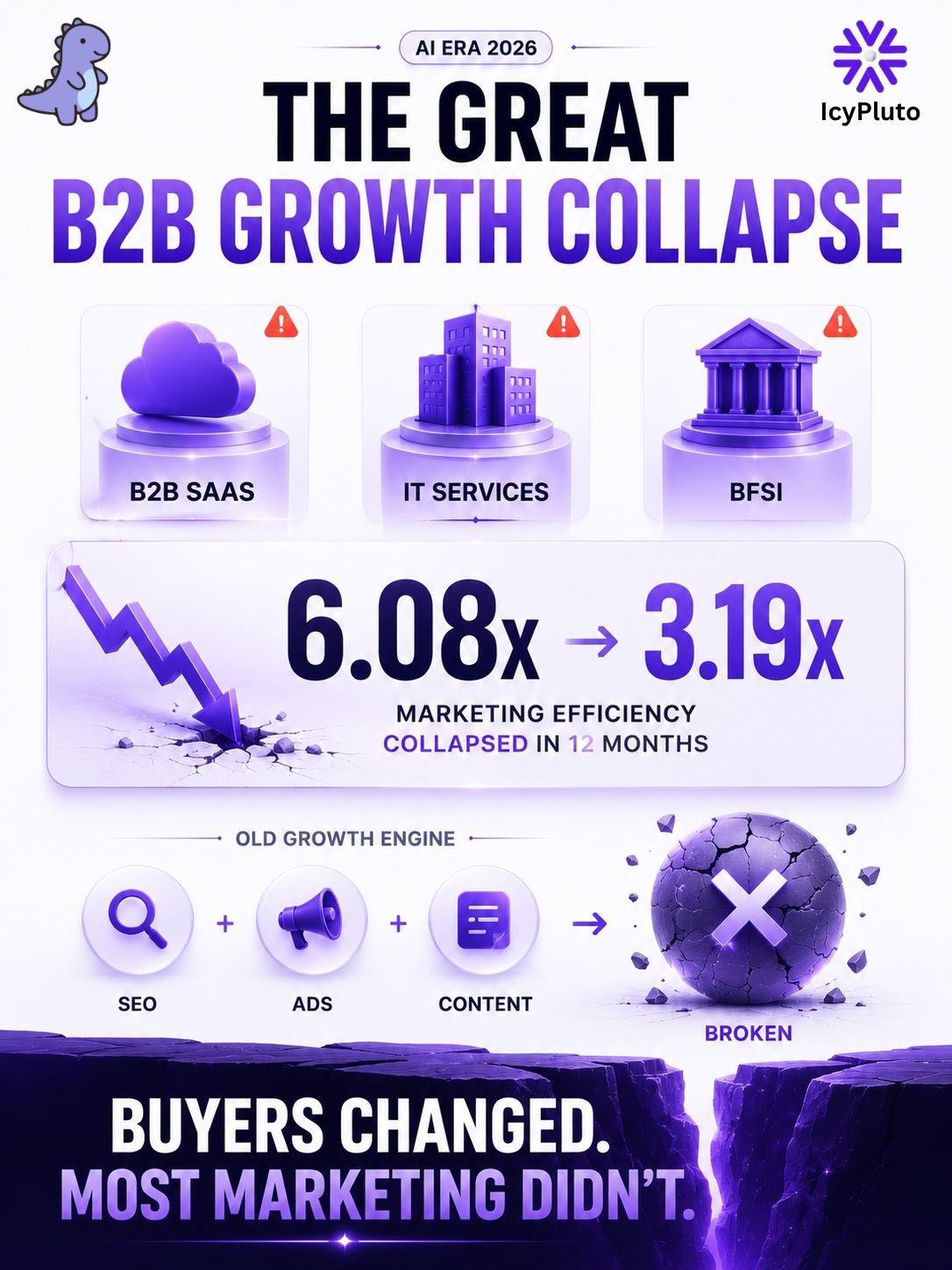
This hard-hitting blog reveals why IT, B2B SaaS, a...
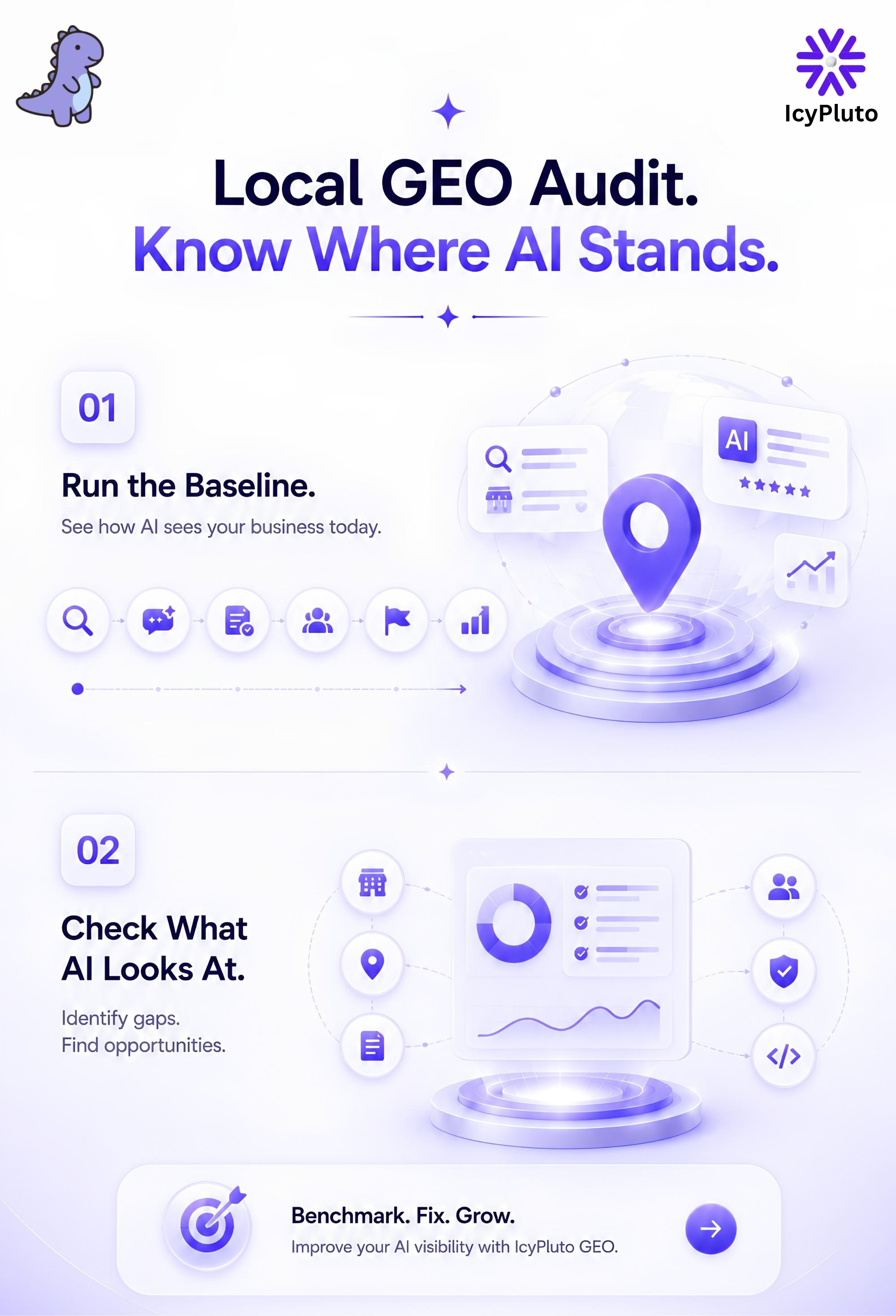
A local GEO baseline audit helps you understand ho...
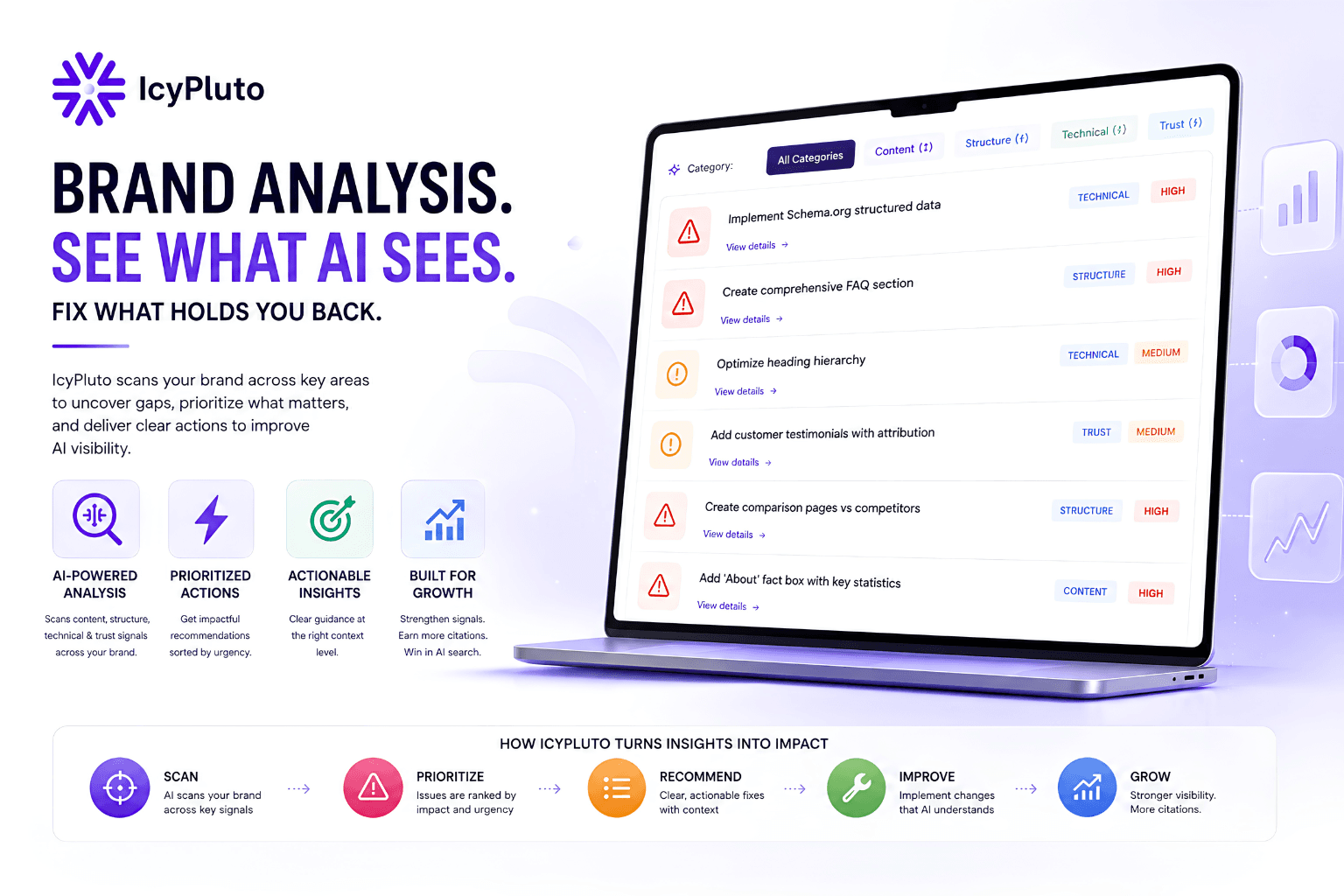
This blog explains why brands are losing visibilit...
The conversation around artificial intelligence and job displacement has been going on for years. But for the first time, researchers have moved beyond theoretical speculation and delivered something far more concrete — a ranked index of 784 U.S. occupations, each assigned a projected risk score for AI-driven job loss. The findings are striking, and for anyone working in digital, creative, or knowledge-based industries, they demand serious attention.
At IcyPluto, where we operate at the intersection of AI and marketing as the cosmos' first AI CMO platform, we've been watching this space closely. This new data doesn't just confirm what many professionals have quietly feared — it reframes the entire conversation about how AI augments, replaces, and reshapes the modern workforce.
Developed by the Digital Planet research group at Tufts University's Fletcher School, the American AI Jobs Risk Index is one of the most comprehensive workforce-risk assessments ever conducted in the context of artificial intelligence. It doesn't just look at whether a job can be done by AI — it goes a significant step further by estimating how likely that AI exposure is to actually translate into measurable, real-world job losses.
The index ranks 784 individual U.S. occupations, covers 530 metropolitan areas, spans all 50 states, and breaks down risk across 20 major industry sectors. Every figure in the index is a model projection based on AI adoption scenarios — not a record of actual layoffs or confirmed employment reductions. Still, the projections are grounded in rigorous methodology, and they paint a picture that professionals across industries would be unwise to ignore.
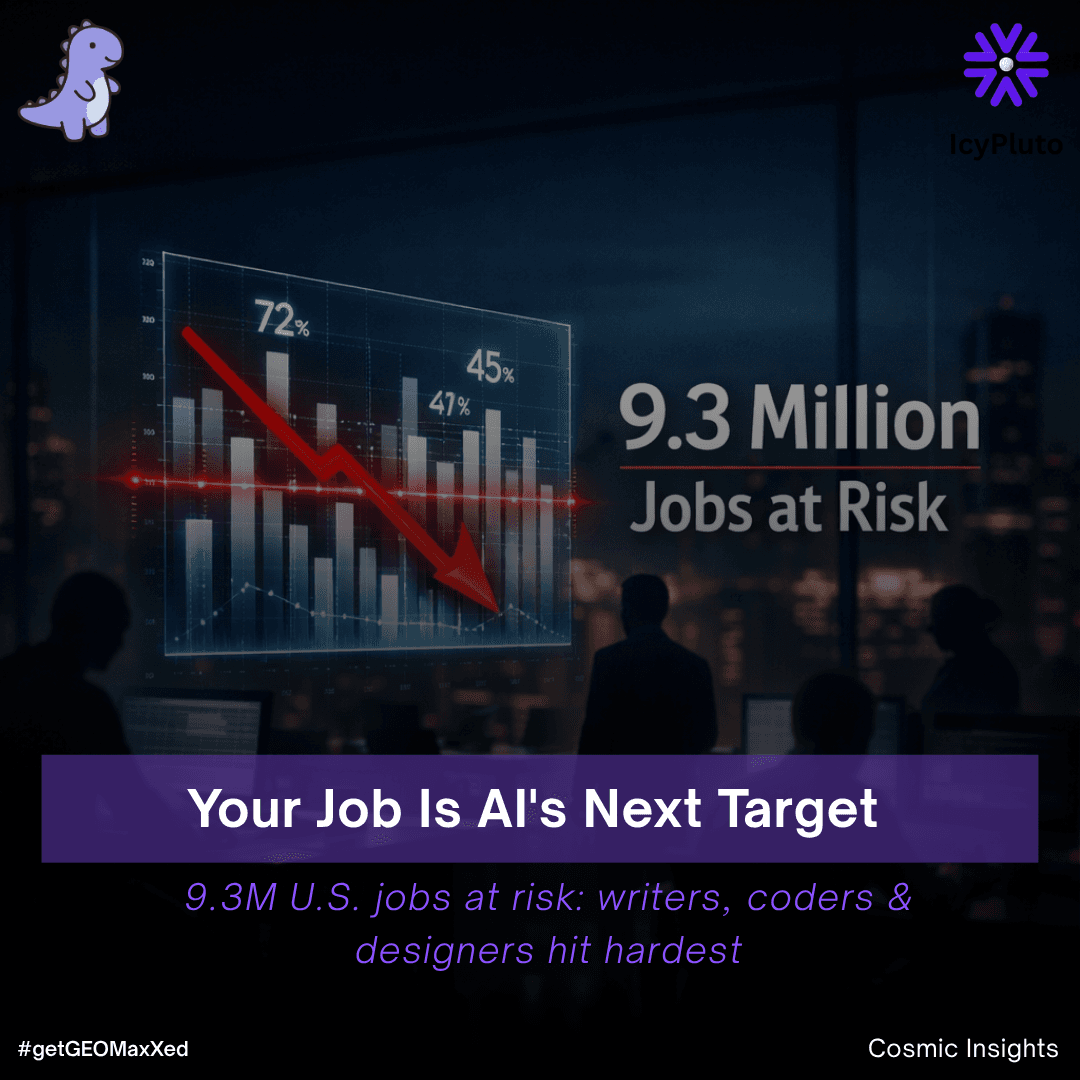
Under the median AI adoption scenario, approximately 9.3 million U.S. jobs are projected to be at risk. That number expands to 19.5 million under an accelerated adoption scenario and narrows to 2.7 million under a conservative one. The range itself tells a story: the outcome depends heavily on how quickly businesses integrate AI tools into their workflows — and right now, that adoption curve is accelerating faster than most labor economists anticipated even two years ago.
What sets this index apart from earlier research — like the Anthropic Economic Index or Stanford's "Canaries in the Coal Mine" study — is its focus on displacement probability, not just AI accessibility. Prior research measured how exposed a job is to AI. This study measures how likely that exposure is to cost someone their position entirely.
The occupations sitting at the top of the risk index will come as a sobering reality check for many in the digital industry. Writers and Authors face a projected job loss rate of 57%, making them the single most vulnerable occupational group in the entire study. Computer Programmers and Web and Digital Interface Designers follow closely at 55% each. Editors sit at 54%, and Web Developers at 46%.
These aren't fringe roles or niche specializations — they are the backbone of the modern digital economy. These are the same professionals who have, for years, been told that using AI tools would secure their relevance by making them more productive. The data tells a more complicated story.
Market Research Analysts and Marketing Specialists face a projected 35% job loss rate. Public Relations Specialists are at 37%. Even News Analysts, Reporters, and Journalists — roles that many assumed required irreplaceable human judgment — face a 35% projected risk.
From IcyPluto's vantage point, this data is particularly relevant to the marketing sector. As an AI-powered CMO platform, we work with businesses navigating this exact tension every single day: how do you harness AI to accelerate marketing output without inadvertently building the case for downsizing the creative teams that make that output meaningful?
One of the most counterintuitive — and genuinely important — findings in the Tufts index is what researchers describe as the "augmentation-displacement link." The occupations where AI delivers the most significant productivity gains are also the ones facing the steepest projected job losses.
The mechanism works like this: when AI enables an individual worker to produce significantly more output in the same amount of time, a company can achieve its goals with fewer employees. Rather than firing existing staff outright, businesses achieve this reduction by simply not replacing workers who leave, cutting back on new hires, and concentrating more responsibilities in fewer hands. The first roles eliminated are entry-level and junior positions — exactly the pipeline through which the next generation of skilled professionals would otherwise develop.
This is most visibly at play in writing, software development, web design, technical documentation, and data analysis. These fields share a set of characteristics that make them particularly vulnerable: the core work is cognitive and language-driven, the tasks are structured and repeatable enough for large language models to execute reliably, and the output is measurable, making productivity gains easy to quantify for executives making headcount decisions.
The implication is stark: being good at using AI tools in these fields doesn't protect your job — it may accelerate the timeline for organizations to conclude they need fewer people doing it.
When the data is aggregated at the industry level, the average projected job loss across all sectors sits at around 6%. But certain industries carry risk that is three times higher than that average.
The Information sector — encompassing media companies, publishers, broadcasters, and software firms — faces the highest projected vulnerability at 18%. Finance and Insurance follows at 16%, as does Professional, Scientific, and Technical Services, another sector at 16%. These are knowledge-intensive, language-driven, data-heavy industries where AI has already demonstrated significant capability, and where productivity-per-employee gains are already being actively tracked.
The financial magnitude of this risk is equally significant. The study projects a total of $757 billion in at-risk annual income across these occupations. Three roles alone — Software Developers, Management Analysts, and Market Research Analysts — account for a disproportionate share of that figure. What makes these roles particularly impactful is the combination of high individual compensation and large workforce sizes. When a high-paying role is at risk at scale, the aggregate economic impact is enormous.
For IcyPluto, this data reinforces our core thesis: the future of marketing isn't about replacing human marketers with AI — it's about fundamentally reimagining what a marketing function looks like when it's powered by intelligent systems. The companies that survive this shift won't be the ones that cut their teams the fastest. They'll be the ones that redesign their workflows intelligently, retaining human judgment where it matters most and allowing AI to handle the volume, velocity, and variability that no human team can sustain alone.
It's important to be precise about what this index is and isn't telling us. The Tufts researchers are transparent about several significant limitations, and those limitations shape how we should interpret the findings.
Most notably, job creation effects are not included in this version of the index. AI adoption doesn't only eliminate roles — it creates entirely new categories of work, new occupations that didn't exist a decade ago, and new demand for skills in areas like AI prompt engineering, model evaluation, AI-assisted content strategy, and automation oversight. The authors acknowledge this gap and have committed to incorporating job creation data in future updates as the evidence base matures.
Additionally, the index doesn't factor in regulatory constraints, union bargaining agreements, or occupational licensing requirements — all of which can significantly slow the pace at which AI-driven displacement actually unfolds in practice. A software engineer at a highly unionized tech firm faces a fundamentally different reality than a freelance developer working in a deregulated market. These structural protections matter, and their absence from the current model means the projections should be read as scenario-based risk estimates, not certainties.
The authors are emphatic that their forecasts describe scenarios, not inevitabilities. The outcome depends on policy decisions, corporate culture, investment in retraining programs, and the pace of technological development — all of which remain in motion.
That said, the projections are consistent with patterns already observable in the labor market. Hiring slowdowns in junior creative and technical roles, growing expectations that individual contributors use AI tools as part of standard workflow, and increased productivity expectations without corresponding headcount growth — these trends are already visible. The index gives them a number.
At IcyPluto, we exist precisely because the transition happening in the marketing workforce is real, significant, and happening faster than most organizations are prepared to handle. As the cosmos' first AI CMO, we sit at the center of this transformation — not as observers, but as active participants shaping how businesses adapt.
What the Tufts data tells us — and what we believe deeply — is that the question is no longer whether AI will change your team's composition. It already is. The more important question is: how do you manage that change in a way that builds long-term capability rather than hollowing out your organization's creative core?
Here's what we see happening across the industry right now, and what we think professionals and organizations need to hear:
1. Augmentation without strategy is still displacement. Giving your content team AI writing tools without redesigning the workflow around them doesn't just boost output — it makes it easy to justify reducing headcount when budgets tighten. Real augmentation requires a deliberate strategy, not just tool adoption.
2. Entry-level is the canary in the coal mine. The Tufts index notes that junior and entry-level roles face the earliest impact as companies slow hiring rather than fire existing staff. This has generational consequences. If the pipeline of new talent can't get started, the senior talent of five years from now doesn't exist. Organizations need to think carefully about what this means for their talent development strategy.
3. The $757 billion income exposure is a signal, not just a statistic. When you're looking at nearly three-quarters of a trillion dollars in at-risk annual income, you're looking at a macroeconomic event unfolding in slow motion. The sectors most exposed — information, finance, professional services — are also the ones most likely to have the resources and appetite to invest in AI-powered platforms. This is both a risk and an opportunity.
4. The roles that survive will be judgment-intensive, relationship-driven, and creatively irreplaceable. AI is extraordinarily good at tasks that are structured, repeatable, and language-based. It is significantly less capable of the kind of contextual, relationship-driven, intuitively human judgment that defines the best marketing, editorial, and strategic work. The professionals who lean into those dimensions of their work — rather than competing with AI on volume and speed — are the ones most likely to thrive.
At IcyPluto, our mission is to help businesses navigate exactly this terrain. We don't believe AI should replace the human ambition behind great marketing. We believe it should amplify it — giving marketing teams the capacity to move faster, think bigger, and focus their human energy on the work that only humans can do.
The American AI Jobs Risk Index is a living document. Its creators have been explicit that future versions will incorporate job creation data, providing a more balanced and complete picture of AI's net impact on the labor market. Updates will also track changes in AI capability and shifts in labor market conditions over time, meaning the index will serve as an ongoing monitoring tool rather than a one-time snapshot.
This matters because the landscape is shifting rapidly. Models that couldn't reliably write a coherent paragraph three years ago can now produce publication-ready copy, functional code, and detailed data analyses at scale. The capabilities enabling the projected displacement in the Tufts index aren't hypothetical — they're in production, in use, right now, across the very industries that face the highest projected risk.
For professionals working in writing, design, programming, marketing, and data analysis, the message from this research isn't doom — it's urgency. The time to rethink how you position your skills, develop new capabilities, and adapt your professional identity to the AI era is now, not after the displacement has already occurred.
For organizations, the message is equally clear. The companies that treat AI as a simple cost-cutting mechanism — using productivity gains to justify headcount reductions without reinvesting in workforce capability — will find themselves with a short-term financial win and a long-term talent deficit. The ones that approach AI strategically, building human-AI workflows that genuinely elevate what their teams can accomplish, are the ones that will define the next era of their industries.
That's the future IcyPluto is building toward. Not a world where AI replaces human ambition, but one where it gives human ambition a much bigger stage to perform on.