In just a few months, LinkedIn has gone from being “one more social network” to becoming one of the most powerful domains in AI search for professional topics. Between mid‑November 2025 and mid‑February 2026, its content has surged to the point where it is now the most-cited domain for professional queries across major answer engines and AI search platforms. That shift has big implications for SEO, Generative Engine Optimization (GEO), Answer Engine Optimization (AEO), and anyone who cares about visibility in tools like ChatGPT, Gemini, Copilot, and Perplexity.
This is no longer only about “ranking in Google.” It is about being one of the very few domains LLMs choose to cite when answering professional questions.
In traditional SEO and Google algorithm thinking, success meant ranking on page one and competing with ten blue links. In AI search mode, users see a synthesized answer with only a handful of citations, often two to seven domains at most. If you are not in that small set, you are effectively invisible, even if your site ranks somewhere in classic search.
Two proprietary AI‑search datasets were used to understand which domains are winning this new visibility battle:
A real‑time prompt‑level citation dataset from ChatGPT, tracking millions of GDPR‑ and CCPA‑compliant user queries over time.
A large answer‑engine insights dataset aggregating billions of citations across nine models, six of which were the focus of this analysis.
Together, they show that for professional queries across AI platforms, LinkedIn has become the single most cited domain. That makes it a central piece of any serious AI SEO, GEO, and AEO strategy for B2B and career‑related topics.
The most striking finding is how quickly LinkedIn moved up the AI search rankings. In November 2025, LinkedIn’s domain rank on ChatGPT sat around position eleven. By mid‑February 2026, it had climbed to roughly position five, representing more than a two‑fold increase in citation frequency over just three months.
During that same period, when analysts looked specifically at professional topic clusters across multiple AI search systems, LinkedIn emerged as the number‑one cited domain overall. That professional‑query analysis used a structured basket of prompts designed to mimic how real professionals search in AI tools, and it was run across:
ChatGPT
Gemini
Google AI Overviews
Google AI Mode
Microsoft Copilot
Perplexity
The domain‑rank metric reflects organic user behavior inside ChatGPT. The “number‑one for professional queries” result comes from a controlled, repeatable test across several engines. When both methods agree, it is a strong signal that LinkedIn has become the dominant professional knowledge graph for AI search.
LinkedIn is a huge ecosystem: company pages, personal profiles, job listings, posts, long‑form articles, newsletters, and more. The analysis dug into which URL types are actually being cited by ChatGPT in responses.
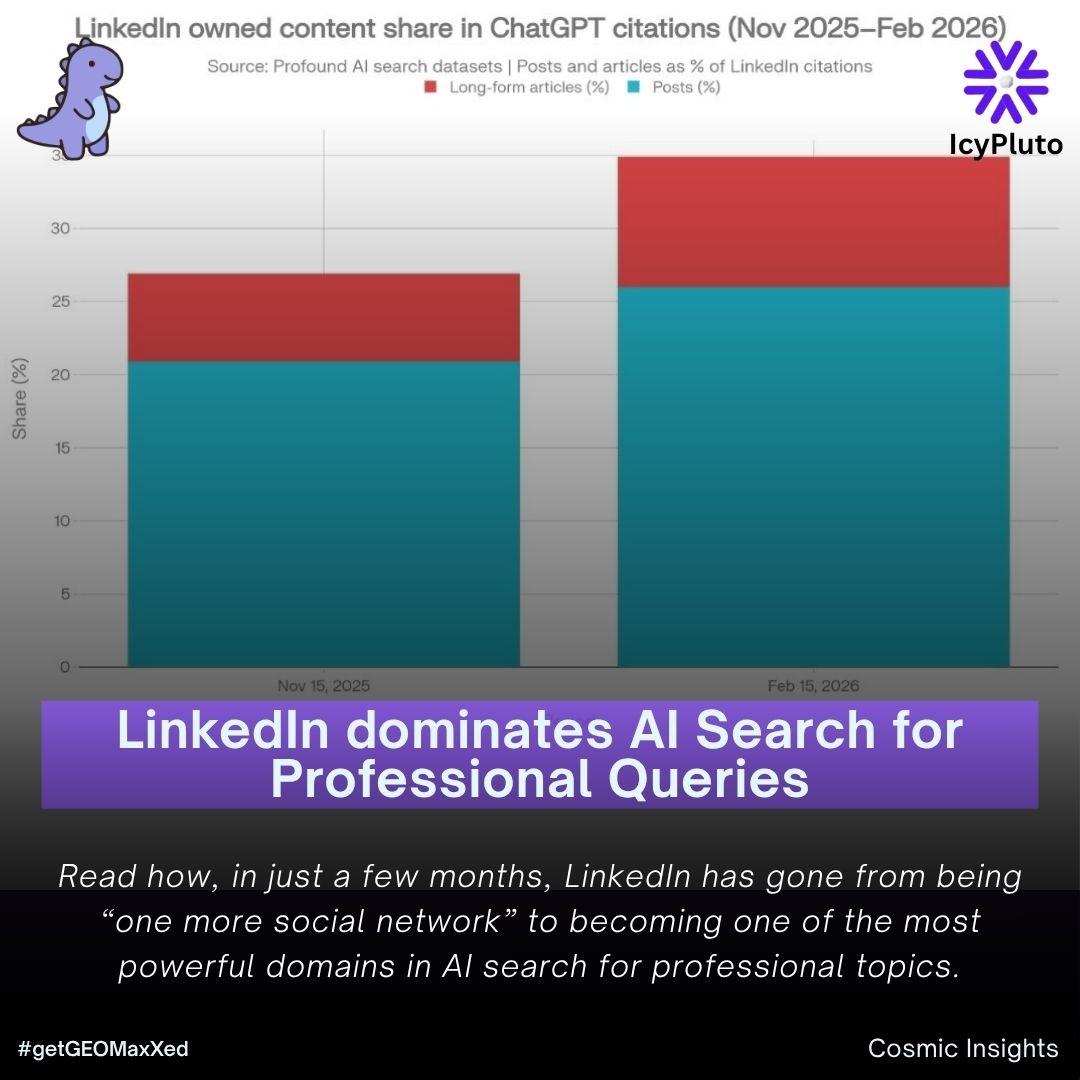
The biggest story is the rise of on‑platform published content: posts, long‑form articles, and newsletters. Together, these content types now make up about 35 percent of all LinkedIn citations in ChatGPT answers, up from roughly 27 percent at the start of the analysis window. That means answer engines are increasingly pulling from thought leadership and expert posts, not just static profiles.
A more detailed breakdown of the three‑month period looks like this:
This means more than one in three LinkedIn URLs cited by ChatGPT are now posts or articles, not just company homepages or profiles.
The chart shows the same story visually: in a short period, the share of LinkedIn citations going to posts and articles has grown meaningfully, which indicates that AI search engines are discovering and trusting LinkedIn’s published content layer more deeply over time.
This shift has an important consequence. If answer engines are citing posts, newsletters, and long‑form articles from LinkedIn, then anyone who publishes on LinkedIn can be a source in AI search.
Two groups benefit most from this change:
Individuals: Subject‑matter experts, operators, freelancers, creators, and job‑seekers can grow reach and credibility when AI engines quote their LinkedIn posts in answers to professional queries.
Companies: Brands can accumulate AI search mentions and citations by investing in on‑platform content from employees and leadership, rather than relying only on blog posts or PR on their own domains.
In practice, that means everything from an SDR’s morning pipeline advice to a product manager’s feature breakdown or a CEO’s quarterly reflection could end up being cited in an AI answer that thousands of people read.
For AI SEO, GEO, and AEO, it reframes LinkedIn as a primary “citation surface” alongside your website, documentation, and media coverage.
There are several reasons AI search systems appear to be gravitating toward LinkedIn for professional information.
Clear professional identity and entities
LinkedIn profiles, company pages, and posts are tightly connected through a graph of job titles, industries, skills, and organizational relationships. That dense entity structure makes it easier for AI models to map “who said what” and “which company does what,” which is essential for confident citations.
High‑signal content around work, skills, and tools
The platform is heavily skewed toward professional context, including real‑world use cases for SaaS products, frameworks, methodologies, and niche B2B topics. For AI search, it is a rich training and retrieval source when answering questions like “How do I structure a B2B SaaS sales team?” or “What does a Staff Data Scientist actually do?”
Freshness and volume
LinkedIn generates a continuous stream of new posts and articles. Combined with domain authority, that helps answer engines balance relevance, authority, and recency, three things that also sit at the heart of modern search ranking systems.
Attribution by design
Every post and article is clearly attached to a person and often to a company. That is valuable for answer engine optimization, because models can attribute insights back to real experts and brands more easily than they can for anonymous forum posts or scraped content.
For SEOs, GEO practitioners, and AEO specialists, the takeaway is simple: LinkedIn has become a primary professional knowledge graph node in AI search.
If LinkedIn is now the number‑one cited domain for professional queries in AI search, you cannot treat it as separate from your SEO and AI search strategy anymore.
Your AI visibility is no longer determined only by your .com domain. It is also shaped by how often AI engines find and cite your LinkedIn presence. That includes:
Personal posts, long‑form articles, and newsletters.
Company page updates and leadership communications.
Employee advocacy content that explains your product, category, or approach.
If you ignore LinkedIn in your GEO and AEO roadmap, you are ignoring one of the highest‑leverage citation surfaces for professional queries.
Static profiles and company pages remain important, particularly for entity validation and brand queries. However, the data shows that answer engines are shifting citation weight toward owned content on top of those profiles.
For a practical strategy, that means you should:
Treat your profile as the schema layer: a clean, entity‑rich representation of who you are and what you do.
Treat your posts, articles, and newsletters as the content layer: the substance that AI search actually quotes, summarizes, and points to.
The timing of LinkedIn’s rise is important. Its domain rank in ChatGPT roughly doubled, and its on‑platform content layer gained citation share within three months, which means the “AI search door” to LinkedIn visibility is still relatively uncrowded.
Most companies and professionals have not yet tuned their SEO, GEO, or AEO plans around LinkedIn citations. Those who move early can:
Build a larger corpus of high‑quality, professionally focused posts and articles.
Accumulate more mentions and backlinks from AI answers.
Strengthen their perceived authority in models that learn over time from past citations.
By the time late adopters show up, they may find a crowded landscape where a small set of early experts dominate AI recommendations for their niche.
You cannot directly “submit” your LinkedIn content to AI engines, but you can make it easier for them to discover, trust, and cite you. Several practical patterns fall out of the data.
Think in terms of answer engine optimization. Write posts and articles that directly address the kinds of questions professionals ask in AI tools, for example:
“How should I structure discovery calls for enterprise SaaS?”
“What metrics matter for product‑led growth in B2B?”
“How do I decide between in‑house and agency SEO in 2026?”
Include clear, structured takeaways. Use headings, bullets, and examples that make it easy for an AI model to extract and summarize the key points.
AI search and GEO rely heavily on entity clarity. Help models understand who you are and what you should be cited for by:
Keeping your headline, “About” section, and experience fields tightly aligned with your core topics and roles.
Using consistent terminology for your niche (for example: “technical SEO for ecommerce,” “B2B demand gen,” “AI search strategy”).
Connecting to relevant companies, certifications, and projects that reinforce your authority graph.
The clearer your entity footprint is, the easier it is for answer engines to attribute your LinkedIn content to a relevant expert.
From a brand perspective, treat LinkedIn as a distributed content network rather than a single company page. To make that network work for AI search:
Set a few core themes or “pillars” for your category (for example: “AI search,” “GEO and AEO,” “ecommerce SEO in AI mode”).
Encourage different team members to publish around those themes from their own perspective: marketing, product, sales, and customer success.
Link posts thoughtfully back to each other and to your main site content when appropriate.
This creates a rich, multi‑voice corpus that AI engines can draw from when answering queries about your problem space.
You can also adopt a more analytical GEO mindset by periodically checking:
Which LinkedIn URLs are being surfaced or cited when you ask AI search tools questions in your domain?
Whether your own posts, your competitors’ content, or third‑party voices dominate those answers.
How AI tools summarize or paraphrase LinkedIn material in their responses.
You will not see full citation analytics without specialized tooling, but even manual checks can reveal patterns that inform your content strategy.
To understand LinkedIn’s role in AI search, the analysis combined:
Organic ChatGPT usage data: millions of real prompts over a three‑month window, tracked on a seven‑day rolling average to smooth volatility. This is where the #11 to #5 domain‑rank movement and the detailed URL‑type shares come from.
Synthetic professional query testing: a carefully designed set of professional prompts that were run across multiple AI search engines to see which domains they favor for work‑related questions.
These methods are complementary:
Domain rank shows how real users are organically causing LinkedIn to be cited in open‑ended conversations.
Professional query testing shows how engines behave when asked consistently framed questions in specific professional categories.
Both agree on the central point: LinkedIn is now the top domain for professional queries in AI search.
For years, SEO advice treated LinkedIn as “nice to have” compared to your blog, documentation, and PR. In 2026, that hierarchy is flipped for professional topics in AI search.
LinkedIn has climbed rapidly in LLM citation rankings, its on‑platform published content now accounts for more than a third of its citations, and answer engines across ChatGPT, Gemini, Google AI Mode, AI Overviews, Copilot, and Perplexity treat it as their primary professional knowledge base.
If you work in SEO, GEO, or AEO, or if you care about how you and your company show up in an AI‑first internet, you should be treating LinkedIn not just as social media, but as search infrastructure. The sooner you align your strategy with that reality, the better your chances of being the expert the AI points to when someone asks, “Who really understands this?”