AI SEO writing is getting more specific, and that ...
A local GEO baseline audit helps you understand ho...
This blog explains why brands are losing visibilit...
Recent benchmarks show how big the gap is. Roughly 60–65% of Google searches now end without a click, AI Overviews can cut organic CTR by 40–60%, and a growing share of discovery happens inside AI interfaces where many answers do not contain any clickable links at all. At the same time, brands that track AI visibility correctly see that being cited and being recommended are not the same thing. Mention counts alone tell you very little about whether AI is actually driving demand.
This is where a modern AI visibility measurement framework comes in. And it is exactly the kind of system IcyPluto is built to run.
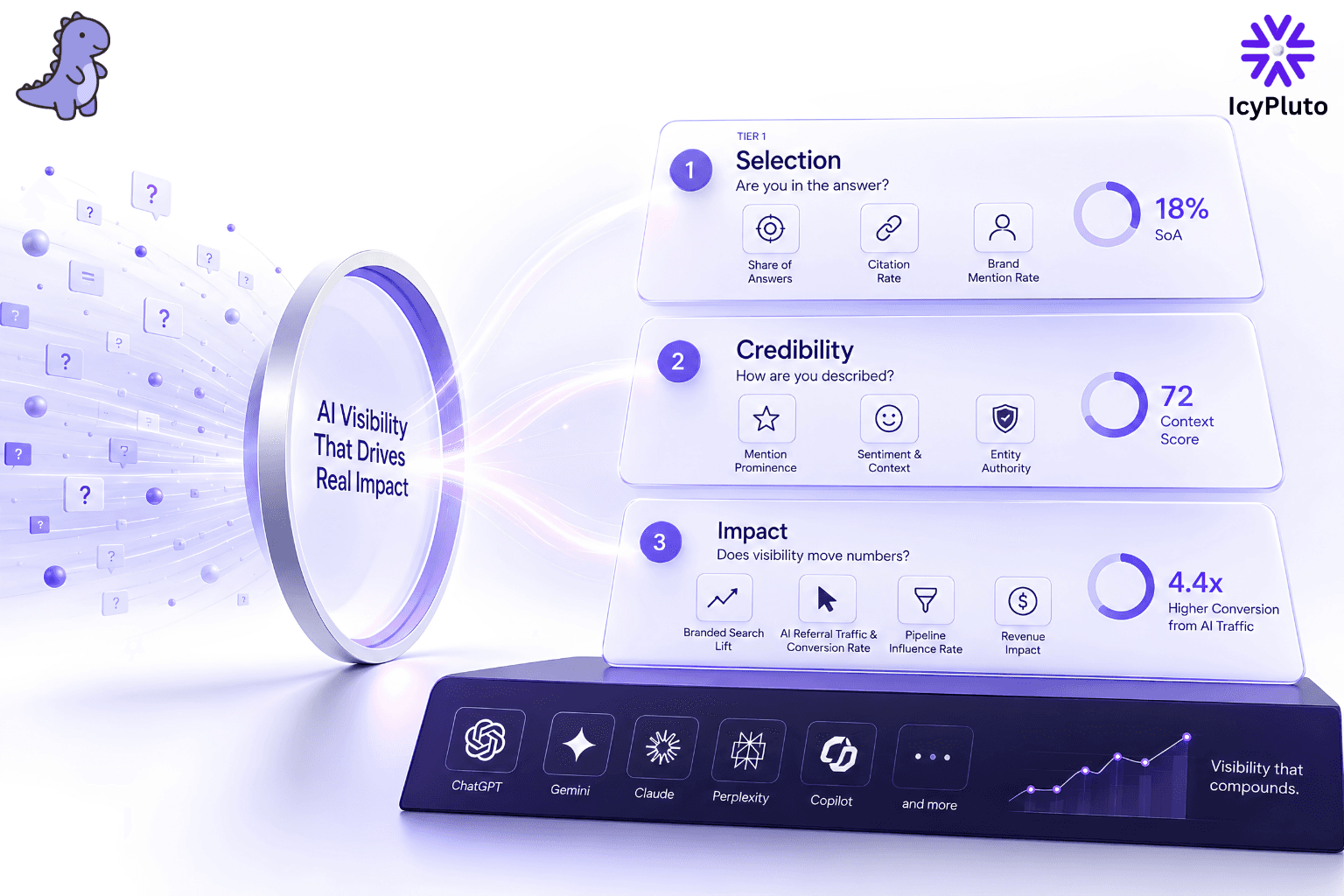
Most AI visibility dashboards promise a single “visibility score.” That feels neat, but it is misleading. Practitioners now agree that AI visibility is a layered picture, not a monolith.
There are three tiers of metrics:
Selection metrics – whether you show up in answers at all.
Credibility and context metrics – how you are positioned and framed.
Impact metrics – whether visibility turns into demand and revenue.
Anything outside these tiers is usually noise.
Selection metrics matter because if you are not in the answer, you do not exist for that query.
Key metrics include:
Answer Presence / Share of Answers (SoA): The percentage of tracked queries where your brand appears in the AI-generated answer.
Citation Rate: The percentage of queries where the answer cites your site, docs, or content as a source.
Brand Mention Rate: The percentage of answers that name your brand at least once.
Strong programs aim for SoA and citation rates in the 15–25% range on priority topics, with 30%+ representing category leadership.
Once you appear, how you are positioned matters.
Important metrics include:
Mention Prominence: Whether you are presented as a top choice, an option among many, or a footnote.
Sentiment / Context Score: Whether the AI describes you positively, neutrally, or negatively, and what labels it uses (premium, budget, niche, etc.).
Entity Authority: How consistently the AI understands your brand’s focus, products, and segment.
Teams monitor these but do not over-optimize for them because sentiment and positioning are influenced by years of reputation, not just a few tweaks.
Finally, there are impact metrics that connect AI visibility to outcomes.
The most useful ones are:
Branded Search Lift: Changes in branded query volume over time.
Direct Traffic To Commercial Pages: Product, pricing, and solution pages that match the queries you track.
AI Referral Traffic & Conversion Rate: How visitors who do click through from AI platforms behave on site.
Pipeline Influence Rate: The percentage of opportunities where prospects report an AI touchpoint in self-reported attribution.
These give you a way to prove that being present in answers is more than vanity. It is influencing awareness, consideration, and revenue.
Just as important as knowing what to track is knowing what to ignore. Several metrics sound appealing but rarely drive good decisions.
Raw mention counts without context. A high mention count can include negative comparisons or low-value queries. Without query and sentiment context, the number is misleading.
Impressions from AI Overviews alone. Impressions without clicks or downstream signals are difficult to translate into business value.
Blended visibility scores across all engines. Different models behave differently. Aggregating them hides per-engine problems and can lead to wrong conclusions.
One-off AI traffic spikes. Referral traffic is volatile and often under-reported. It is useful for pattern recognition, not as a primary success metric.
The strongest advice from practitioners is clear: track prompts, per-engine visibility, and self-reported attribution; only monitor citations, sentiment, and raw referral traffic. Do not chase them directly.
IcyPluto was designed around this layered view of AI visibility. Instead of a single score, it gives marketing teams a structured measurement stack and connects visibility to actions.
Everything starts with the prompt set—the exact questions your customers actually ask AI engines.
IcyPluto helps you:
Build prompt families based on buyer research, search data, and AI usage patterns.
Separate prompts by funnel stage (awareness, consideration, decision).
Maintain a stable test set so visibility metrics track changes in reality, not random prompt variations.
This aligns directly with practitioner guidance that prompt-level presence is more useful than raw keyword lists in the AI era.
Instead of giving you one blended visibility number, IcyPluto tracks per-engine visibility across ChatGPT, Gemini, Claude, Perplexity, Copilot, and others.
For each engine and prompt family, the platform logs:
Whether your brand appears (answer presence).
Whether your site or assets are cited (citation rate).
Where you are positioned in the answer (prominence).
This follows the recommendation that measuring visibility separately for each model is essential because the same query can produce different brands on different systems.
IcyPluto’s dashboards include the selection and credibility metrics practitioners say matter most:
Share of Answers (SoA) at topic and engine level.
Citation Share – the percentage of answers that cite your domain.
Brand Mention Rate and Prominence – how often and where your brand appears in answers.
Sentiment and Context Tags – key phrases and labels associated with your brand.
You can see which prompts and engines treat you as a main recommendation, which treat you as an alternative, and where you are missing entirely.
IcyPluto integrates AI visibility with your existing analytics and reporting so you can see impact.
The platform helps you:
Overlay AI visibility trends with branded search volume from Search Console.
Track direct and AI referral traffic to important commercial pages.
Add self-reported attribution fields such as “Found us via ChatGPT / AI search” to lead and opportunity forms.
Correlate visibility improvements with changes in pipeline volume, velocity, and win rates.
This follows frameworks that advise CMOs to prove ROI through share of AI voice, branded search lift, direct traffic to commercial pages, and pipeline influence.
By default, IcyPluto highlights the KPIs that should guide decisions and pushes vanity metrics into the background.
Priority:
Prompt coverage and per-engine visibility.
Share of Answers and Citation Share on critical prompts.
Branded search lift and pipeline influence.
Secondary:
Raw mention counts.
Sentiment swings on low-intent queries.
One-off traffic spikes.
This design is intentional. It keeps teams focused on recommendation and action, not just being named.
AI visibility measurement is not just about better reporting. It is about making Generative Engine Optimization (GEO), Answer Engine Optimization (AEO), and demand generation work together.
GEO teams need to know which topics and prompts they are winning and losing in AI answers.
AEO efforts must be measured by how often specific pages are cited and in what contexts.
Demand-gen leaders must see whether targeting AI-heavy topics translates into branded search and pipeline growth.
IcyPluto sits at that intersection. It:
Provides prompt-aware visibility metrics that GEO teams can optimize against.
Shows page-level citation behavior for AEO and content teams.
Connects visibility gains to downstream demand signals for growth and revenue teams.
In other words, it turns AI visibility from a vague concept into a set of KPIs that drive planning, prioritization, and proof.
The core message behind modern AI visibility measurement is simple: stop chasing vanity metrics, start tracking the few signals that actually reflect how AI reshapes your market.
Those signals are:
The prompts your buyers use.
Whether you appear in answers per engine.
How you are positioned.
Whether that presence lifts branded search, direct traffic, and pipeline.
IcyPluto is built to track exactly those signals across ChatGPT, Gemini, Claude, Perplexity, and more, then turn them into practical actions. It does not just tell you if you are visible. It shows you where, how, and whether that visibility matters.
For teams serious about winning in the AI era, that is the difference between staring at noisy charts and running a visibility system that actually moves revenue.