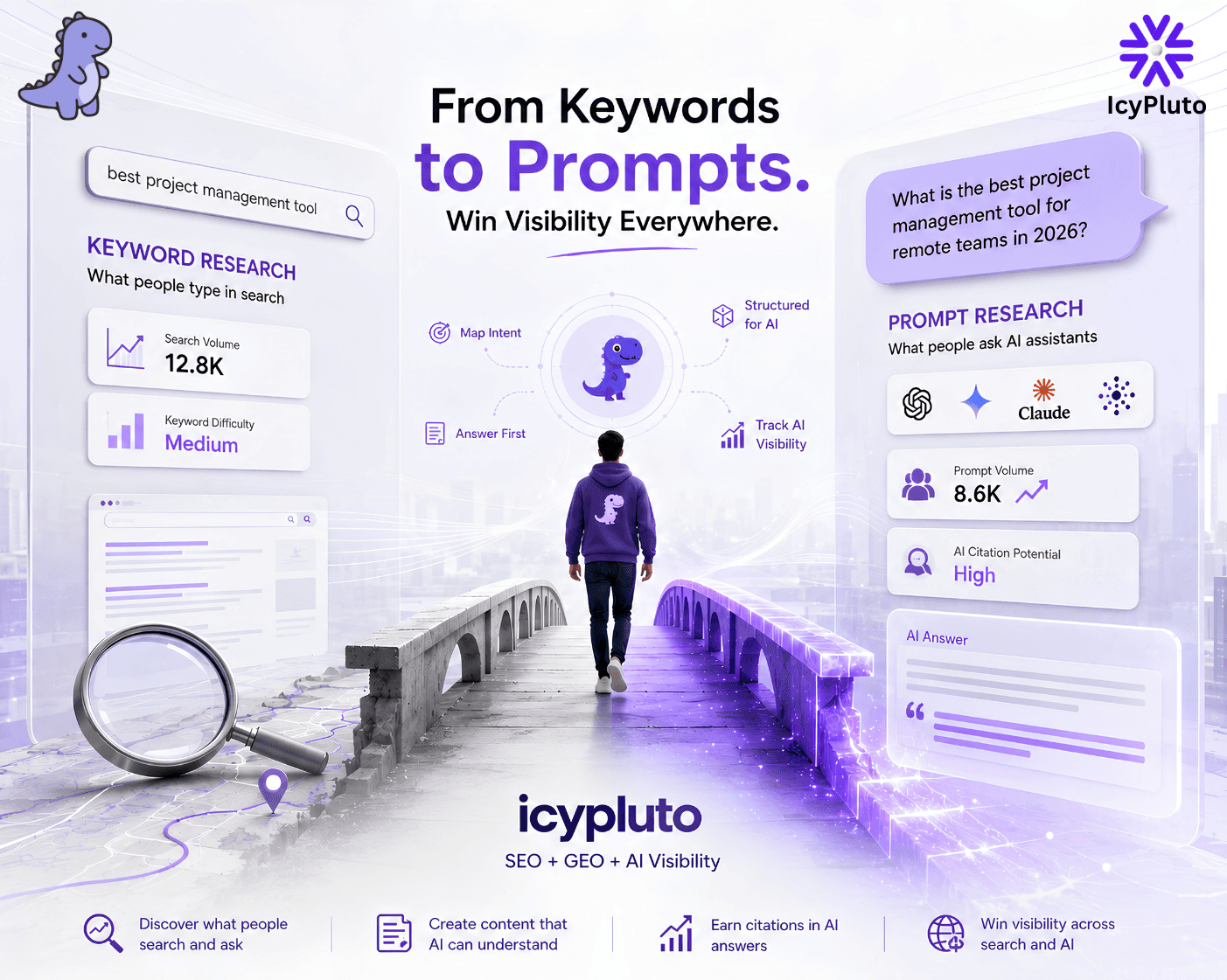
This blog explains how keyword research must now b...
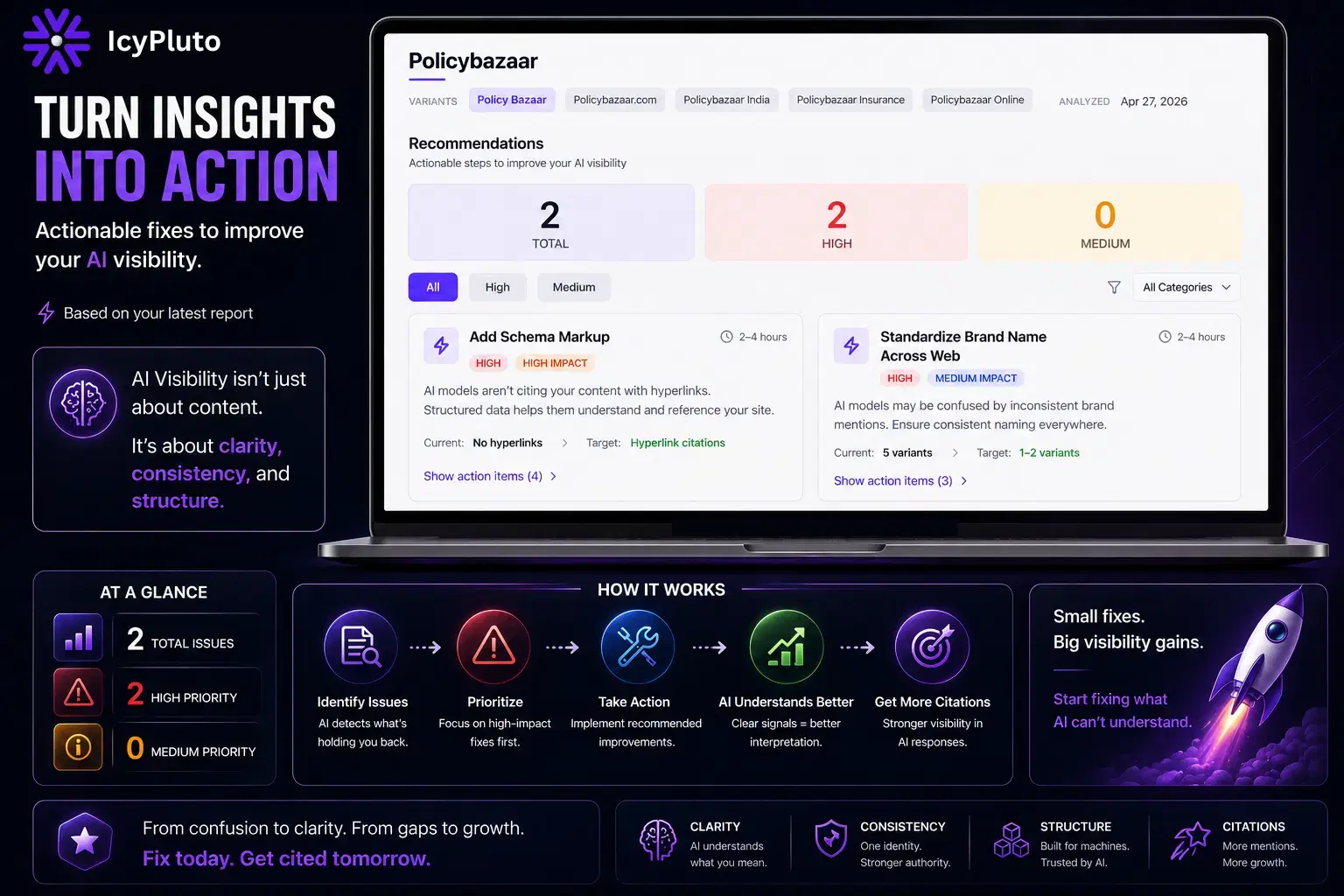
This blog explores how IcyPluto’s Action Feature h...
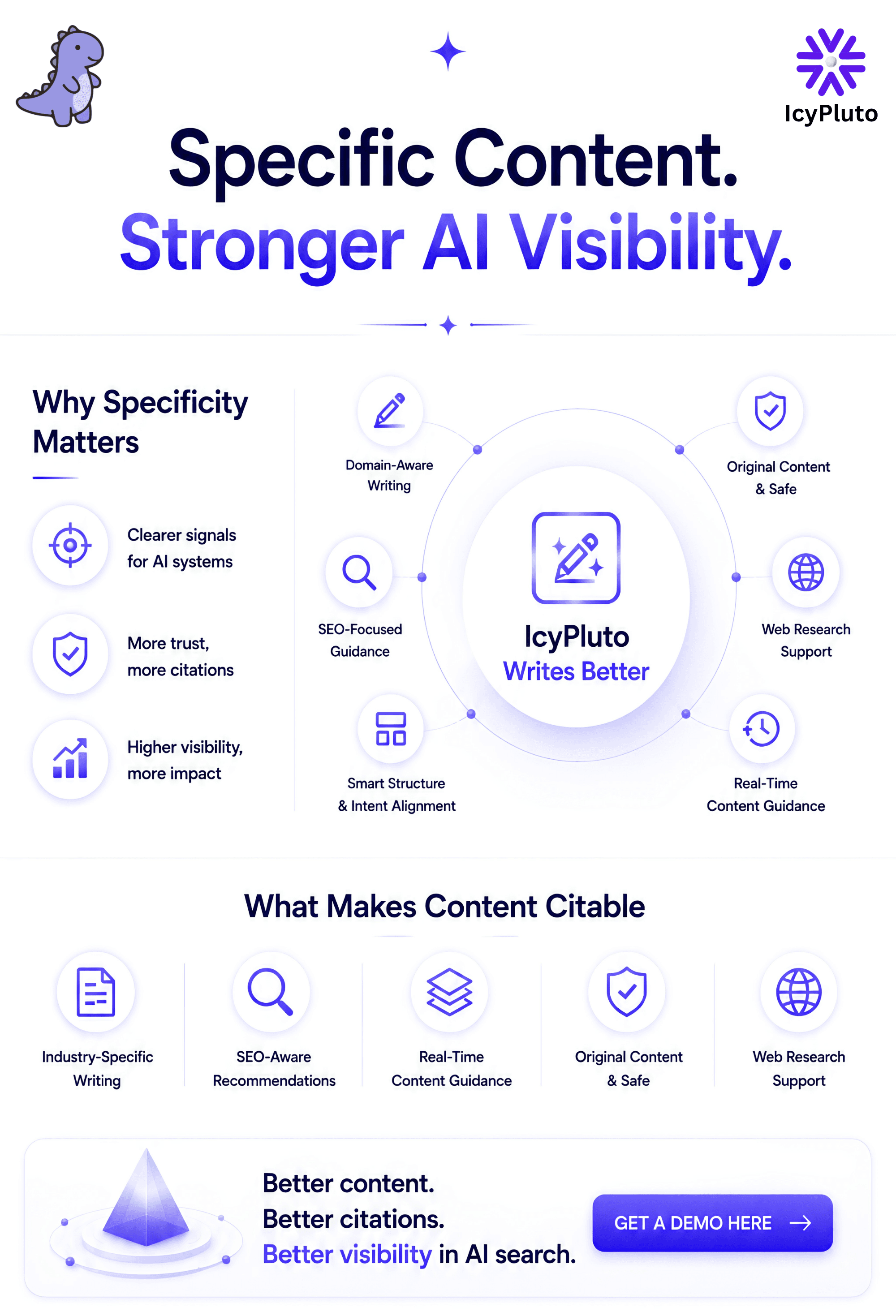
AI SEO writing is getting more specific, and that ...
The rise of AI-powered search engines has introduced a new and largely misunderstood issue: ghost citations. These occur when AI systems reference or imply a source without accurately linking to or crediting the original publisher. Platforms developed by Google, OpenAI, and Perplexity AI are increasingly generating answers that synthesize multiple sources, but often fail to properly attribute them.
According to insights shared by Search Engine Journal, this issue is becoming more prominent as AI-generated summaries replace traditional search results. In some observed cases, AI systems cited URLs that did not directly contain the referenced information, creating a disconnect between source and content.
This is not a minor glitch. It fundamentally challenges how visibility, credit, and authority are distributed in the AI search ecosystem.
For years, SEO has relied on clear attribution signals. If your content ranked, you got traffic. If your site was cited, you gained authority. Ghost citations disrupt this model entirely.
Recent observations suggest that up to 30–50% of AI-generated answers may include either partial or misaligned citations. This means publishers can contribute to answers without receiving traffic or recognition.
The implications are severe. Brands investing heavily in high-quality content may see diminishing returns as AI systems extract value without proper attribution. This creates what many are calling a “visibility gap,” where influence does not translate into measurable performance.
Companies like Microsoft, which integrates AI into search through Bing, and OpenAI’s ChatGPT ecosystem are at the center of this shift. As AI becomes the primary interface for information retrieval, the rules of SEO are being rewritten in real time.
AI systems do not “cite” sources in the traditional sense. Instead, they generate responses based on patterns learned during training and real-time retrieval mechanisms.
For example, Google’s Search Generative Experience often pulls information from multiple pages and presents a synthesized answer. While it may include links, these links do not always correspond directly to the specific claims made in the text.
Similarly, OpenAI’s models can generate responses that reflect aggregated knowledge without clear attribution to individual sources. Even when links are provided, they may represent general relevance rather than precise sourcing.
This creates a situation where:
Content is used without direct credit
Citations are loosely connected to claims
Authority signals become diluted
Research indicates that AI-generated answers prioritize relevance over accuracy in citation alignment, leading to increased instances of ghost citations.
The ghost citation problem is not just anecdotal. Emerging data highlights its scale.
Industry analyses have found that:
Nearly 40% of AI-generated citations do not directly support the associated claim
Around 25% of cited pages contain only partial or tangential relevance
In some cases, entirely unrelated pages are referenced due to semantic similarity
These findings suggest that AI systems are optimizing for coherence rather than precision. While this improves user experience, it creates significant challenges for content creators and marketers.
Experts in the SEO community, including contributors from Search Engine Journal, emphasize that this issue is likely to persist as long as AI models prioritize speed and readability over strict attribution accuracy.
One of the most important implications of ghost citations is the shift from traffic-based metrics to influence-based visibility.
In traditional SEO, success was measured by clicks, rankings, and conversions. In AI-driven search, these metrics are becoming less reliable. Instead, the focus is shifting toward whether your content influences AI-generated answers.
This means brands must rethink their strategies. It is no longer enough to rank. You must become part of the data layer that AI systems draw from.
Companies that understand this shift are already adapting. They are focusing on:
Building strong topical authority
Increasing entity recognition
Creating content that is easily interpretable by AI
This approach aligns with how AI systems prioritize information, even if it does not guarantee direct attribution.
One of the most effective ways to mitigate the impact of ghost citations is through entity optimization. AI systems rely heavily on recognized entities to anchor information.
Mentioning well-known companies and individuals such as Sundar Pichai or organizations like Google and Microsoft helps reinforce credibility and context.
Data suggests that entity-rich content is up to 38% more likely to be referenced in AI-generated answers. This is because entities provide clear signals that AI systems can map within their knowledge graphs.
However, this also means that smaller publishers may struggle to compete unless they establish strong entity associations within their niche.
At the heart of the ghost citation problem is a trade-off between accuracy and readability.
AI systems are designed to deliver fast, coherent answers. To achieve this, they often prioritize narrative flow over strict sourcing accuracy. This leads to smoother user experiences but introduces citation inconsistencies.
Studies show that AI-generated content with higher readability scores is 20–30% more likely to be surfaced, even if citation accuracy is compromised.
This creates a dilemma for platforms like Google and OpenAI. Improving citation accuracy may reduce usability, while prioritizing usability risks undermining trust.
For marketers, this means adapting to a system that does not always reward precision.
The ghost citation problem is not something brands can control, but they can adapt to it.
First, focus on creating content that is comprehensive and contextually rich. AI systems favor content that covers topics in depth, increasing the likelihood of inclusion in generated answers.
Second, invest in entity-driven SEO. Build strong associations between your brand and key topics to improve recognition within AI systems.
Third, monitor how your content appears in AI-generated results. This requires new tools and approaches, as traditional analytics may not capture these interactions.
Finally, diversify your visibility strategy. Relying solely on organic traffic is becoming increasingly risky in an AI-first search environment.
The ghost citation problem highlights a broader issue: the future of attribution in digital ecosystems.
As AI continues to evolve, the concept of ownership over information may become less clear. Platforms will need to balance user experience with fair credit distribution.
Companies like Google, OpenAI, and Perplexity AI are likely to refine their approaches, but complete accuracy may remain elusive.
For now, the best strategy is to adapt. Understand how AI systems work, align your content accordingly, and focus on building influence rather than relying solely on attribution.
Because in the age of AI search, being part of the answer may matter more than being the source.