This blog explains how modern marketing teams can ...
Citation seeding is becoming one of the fastest wa...
This blog explains why brands are losing visibilit...
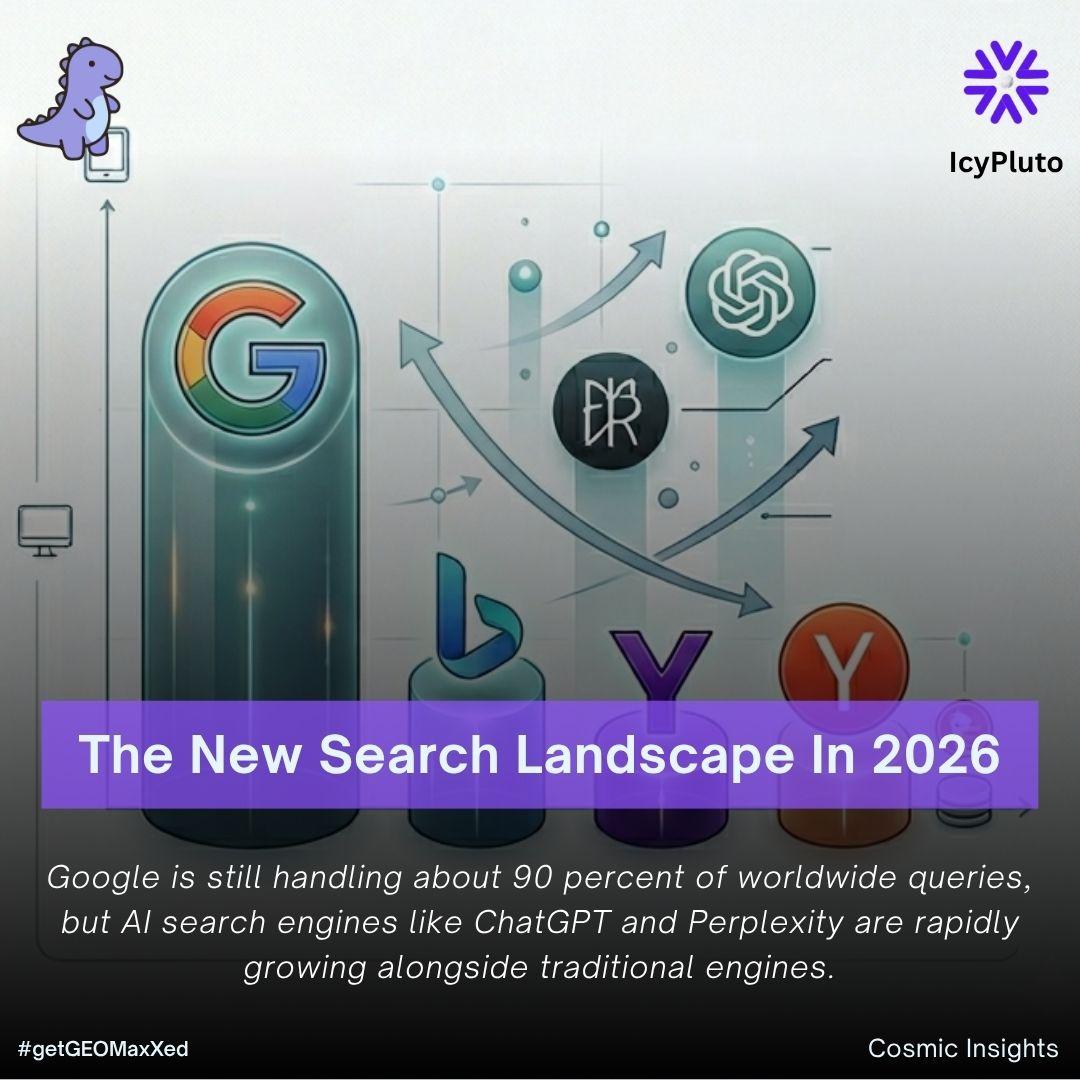
For more than a decade, SEO professionals could safely assume one thing. If you won on Google, you effectively won in search. Google’s global market share hovered between 91 and 93 percent and every SEO strategy, content roadmap and GEO plan was built around that single search engine.
In early 2026, that picture is starting to change. Google still dominates, but its share is edging down, alternative engines are strengthening specific niches, and a new layer of AI search engines is quietly absorbing more and more discovery. Traditional SEO, GEO and answer engine optimization now all sit inside a multi platform search ecosystem, not a Google only world.
This article walks through what the latest search engine market share data tells us, how AI search fits in, and what that means for your SEO and GEO strategy in the age of Google algorithms and AI powered ranking systems.
Most of the major datasets agree on the same broad story. Google is still the primary driver of search traffic, yet its market share is no longer untouchable.
According to Statcounter’s worldwide data for March 2026, the desktop and mobile search market looks roughly like this:
Google: about 89.8–90.0 percent of global search traffic
Microsoft Bing: around 5.0 percent
Yahoo: roughly 1.4 percent
Yandex: about 1.3 percent
DuckDuckGo: about 0.7–0.8 percent
Baidu: around 0.5 percent
ResourceRa’s 2026 analysis based on similar data paints a comparable picture. It shows Google with about 90.0 percent global share across all devices, followed by Bing at 4.3 percent, Yandex at 1.8 percent, Yahoo at 1.5 percent and DuckDuckGo at 0.9 percent.
So from a pure SEO traffic point of view, Google is still where nine out of ten measured queries go. At the same time, several important trends are hidden behind that headline number.
Google’s share has drifted down by roughly half a percentage point over the last several years, while Microsoft Bing has crept upward.
In the United States, Google’s share is lower and Bing’s is higher than the global average, particularly on desktop.
Zero click behavior on Google is increasing as AI Overviews, featured snippets and other on SERP features answer more queries directly.
A growing slice of search like behavior now happens inside platforms that do not show up in classic search engine market share charts, including Amazon, TikTok and AI native tools such as ChatGPT and Perplexity.
To build a realistic SEO strategy in 2026, you have to look past the top line Google share and understand how the big engines and emerging AI search experiences fit together.
Search Engine Journal’s overview of the top search engines focuses on the six platforms that together account for almost all measured web search queries worldwide. Each one plays a slightly different role in SEO, GEO and search marketing.
Google continues to lead by a wide margin. Statcounter and other data sources put Google at about 90 percent global share, processing an estimated 8.5 billion queries per day and generating over 300 billion dollars a year in ad revenue.
Google’s dominance is even higher on mobile, where it can exceed 94 percent global share, thanks to Android defaults and deep integration with Chrome, Maps and other Google properties. On desktop, its share is lower, often in the low 80s, which leaves more room for Bing and others to matter regionally.
Over the last year, the most significant change on Google has not been an algorithm update in the classic sense, but the expansion of AI Overviews. These AI generated summaries sit at the top of many results pages and answer the query before a user scrolls to organic links.
Combined with featured snippets, People Also Ask boxes, local packs and shopping units, AI Overviews have pushed organic results lower and increased the percentage of searches that end without a click. Recent estimates suggest that 58 to 62 percent of Google searches now result in no external click at all.
For SEO, GEO and content teams, Google is still non negotiable, but the cost of winning clicks has increased. You are not only competing with other websites inside the Google algorithm. You are also competing with Google’s own on page experiences and AI search answers.
Globally, Bing’s share looks modest at around 4 to 5 percent, yet that understates its impact in specific markets and devices.
In the United States, Bing’s share can reach 9 to 11 percent overall, and on desktop it often passes 10 percent, helped by its distribution as the default engine on Windows, Edge and many enterprise environments. In some corporate or government networks, Bing is the primary search experience.
Microsoft has layered its Copilot AI assistant on top of Bing search results, providing an AI search interface similar to Google’s AI Overviews. These experiences combine classic web rankings with generative answers inside a single interface, which means Bing is both a traditional search engine and a gateway into AI search behavior.
For B2B SaaS, enterprise software and industries where Windows remains standard, Bing SEO and GEO often deliver above average returns relative to its global share, especially from desktop traffic.
Yahoo accounts for roughly 1.3 to 1.5 percent of searches worldwide and closer to 2.5 to 3 percent in the United States.
Yahoo’s search results are powered by Bing’s index and ranking systems, which means there is no separate Yahoo algorithm to optimize for. However, Yahoo still maintains popular entry points such as Yahoo Mail, Yahoo Finance and Yahoo News. Users who live inside these properties often use the embedded Yahoo search box rather than switching to Google.
From an SEO perspective, you rarely need Yahoo specific tactics. Optimizing well for Bing automatically covers Yahoo. From a GEO point of view, Yahoo can matter in markets like Japan and Mexico, where the brand retains stronger local usage.
Yandex has a global market share of around 1.3 to 1.8 percent, but that figure hides its dominance in Russia and some neighboring countries. In Russia, Yandex has historically captured well over half of all searches, competing closely with Google.
Yandex uses its own ranking systems and algorithmic signals, including content quality, user behavior and a strong emphasis on Russian language understanding. For brands doing GEO or multilingual SEO targeting Russia and CIS countries, Yandex SEO is critical. For everyone else, its impact is limited.
DuckDuckGo holds less than one percent of global market share, but it punches above its weight in certain audiences and regions.
In the United States, DuckDuckGo’s share can be close to two percent, and among privacy conscious users it can be significantly higher. Its growth has been steady rather than explosive, driven by concerns about tracking and data collection.
DuckDuckGo sources results from multiple places, including Bing’s index and its own crawler, so there is rarely a need to optimize specifically for it. If you are performing solid SEO for Google and Bing, your content will appear appropriately on DuckDuckGo as well.
Globally, Baidu’s share appears tiny at around 0.5 to 0.8 percent. Within mainland China, it is still the leading search engine with over half the local market despite rising competition.
For any SEO or GEO strategy targeting Chinese users, Baidu is not optional. It has its own algorithm characteristics, language processing and content regulations. For most international brands without a China strategy, Baidu’s presence in global stats is simply a reminder that worldwide averages hide deep regional variation.
The six engines above represent search that is relatively easy to measure. However, an important part of the 2026 story sits outside these charts. AI native search engines and AI powered interfaces are handling a growing share of search like behavior.
An analysis by Infront and others suggests that AI search can be divided into two categories:
AI powered features inside traditional engines, such as Google’s AI Overviews and Microsoft’s Copilot interface over Bing results.
AI native tools where users ask questions directly to an AI, including ChatGPT, Perplexity, Grok and similar answer engines.
Based on 2025 data from Statcounter, Similarweb, Semrush and SparkToro, traditional engines still handle about 90 percent of global queries, with Google responsible for most of that volume. AI native tools appear small by comparison, with perhaps 2 to 5 percent of global search like queries and tens of millions to roughly 1 to 2 billion questions per day.
Yet growth rates tell a different story. Estimates show that ChatGPT’s query volume has increased roughly eight times since 2022, while total AI search share including AI overviews inside Google may already sit around 5 to 10 percent of all queries.
For SEO and GEO teams, this leads to an important conclusion. AI search engines are not replacing Google overnight. Instead, they are gradually absorbing queries at the margins, often high intent questions that used to produce a click to your site but now end with an AI generated answer and a small set of citations.
AI search engines do not exist in a vacuum. They are layered on top of, or adjacent to, classic web indexes and Google style ranking systems.
Consider a few key interactions:
Google’s AI Overviews heavily depend on Google’s own index, Core updates and spam systems to decide which content is safe and useful to summarize. Your visibility in AI Overviews is still rooted in how Google’s algorithm evaluates your site.
Bing’s Copilot interface uses Bing’s ranking systems as its underlying retrieval layer, then synthesizes that information into conversational answers. Strong Bing SEO improves both classic rankings and Copilot visibility.
AI native engines such as ChatGPT and Perplexity rely on web crawlers like ChatGPT‑User, GPTBot and PerplexityBot to fetch high quality sources in real time. Those crawlers tend to favor sites with clean HTML, clear topical authority and strong structured data, all of which are core SEO practices.
In other words, optimizing for AI search does not replace SEO. It extends SEO into new surfaces and ranking systems that value many of the same fundamentals while adding new constraints such as licensing preferences, freshness and answer friendly structure.
Putting all these signals together, several strategic implications emerge for SEO, GEO and digital growth teams.
With around 90 percent global share and even higher dominance on mobile, Google is still the primary channel for organic search and GEO campaigns. You cannot ignore Google’s algorithms, core updates or AI Overviews.
At the same time, the incremental gains from only optimizing for Google are shrinking. As zero click behavior rises and on SERP content absorbs more queries, each additional SEO win on Google delivers less traffic than it used to. That creates room to invest selectively in other engines and AI search platforms that offer better relative returns in certain regions and verticals.
If your target markets include the United States, Western Europe or enterprise buyers, Bing and Yahoo together can represent 10 to 20 percent of desktop search traffic and a meaningful share of B2B discovery.
If your GEO strategy includes Russia or CIS countries, Yandex is essential. For China, Baidu and local engines should anchor your localized SEO efforts.
The good news is that most best practices transfer well. Technical SEO, content quality, localized keyword research and strong site architecture help across engines. You may need to fine tune for local ranking factors, but you rarely need to build completely separate optimization programs.
Answer engine optimization is no longer a theoretical concept. AI Overviews, ChatGPT, Perplexity and other AI search engines already influence how users discover and evaluate brands, even when classic rankings are unchanged.
To adapt, SEO and GEO teams can:
Structure content around clear questions and answers so AI models can extract accurate, context rich responses.
Use headings, FAQ sections and schema markup to highlight core answers inside longer pages.
Monitor logs and analytics for AI crawler activity, including ChatGPT‑User, GPTBot, PerplexityBot and others, and ensure they can reach your key content.
Consider content licensing, robots.txt policies and AI training preferences so you control how your material is used while still appearing in AI search results.
You can think of this as optimizing not only for Google’s algorithm and rankings, but for a second tier of AI ranking systems that decide which sources to cite in conversational answers.
Most SEO dashboards still show search engine breakdowns as Google versus Bing versus everything else. That view understates the real fragmentation of discovery.
Forward looking teams are beginning to track:
Search engine market share by device and country for their actual traffic, not just global averages.
AI search referrals where possible, such as direct visits from ChatGPT shared links, Perplexity answer pages and Bing Copilot click outs.
On SERP visibility, including presence in AI Overviews, featured snippets and other rich result types.
Changes in click through rates by query type as AI elements expand.
This richer measurement helps you decide how much budget to allocate to classic SEO, GEO, paid search, AI search optimization and on platform content such as TikTok or Amazon.
To turn these insights into execution, SEO and GEO teams can take a structured approach.
Benchmark your current traffic mix by engine, device and country using analytics and Statcounter type data as context.
Make sure your technical SEO foundations are in excellent shape for Google and Bing. Fast, secure, mobile friendly pages with clean HTML, solid Core Web Vitals and clear internal linking remain non negotiable.
Identify one or two priority regions where Yandex, Baidu or other engines matter for GEO and build targeted playbooks for those markets.
Audit your content for AEO readiness. Add or refine FAQ sections, improve heading structure and introduce schema where it helps AI search and Google algorithms understand context.
Monitor AI crawler activity and adjust robots.txt so retrieval bots like ChatGPT‑User can reach your public content while you retain control over training bots if needed.
Expand reporting to include on SERP presence, AI search citations and engine level performance instead of viewing everything only through the lens of “Google organic traffic.”
Search in 2026 is no longer a one engine game. Google still sets the tone, yet AI search engines, regional players and new ranking systems are quietly redrawing the map. The teams that treat SEO, GEO and AI search as a unified strategy rather than separate silos will be in the strongest position as this shift accelerates.