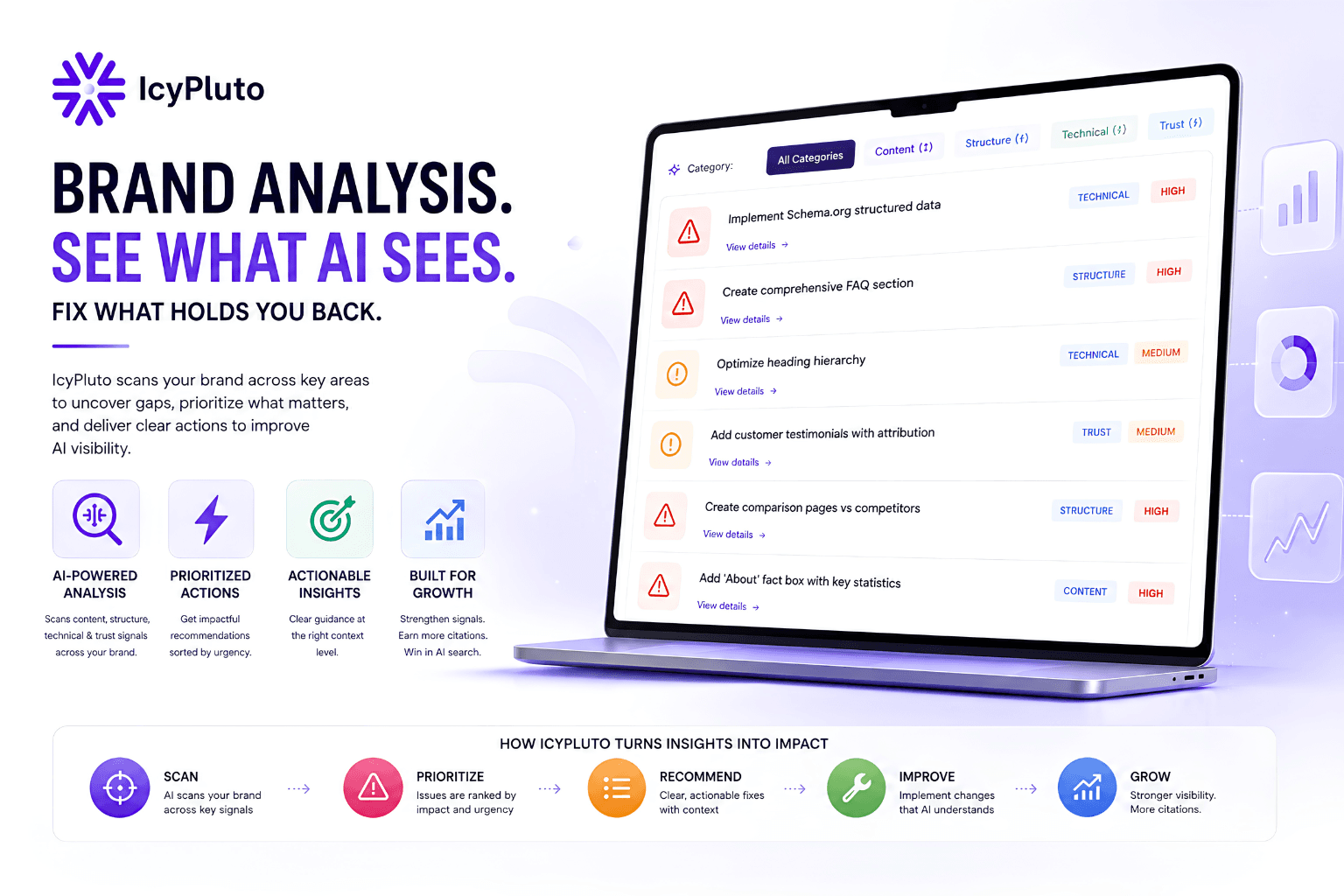
This blog explains why brands are losing visibilit...
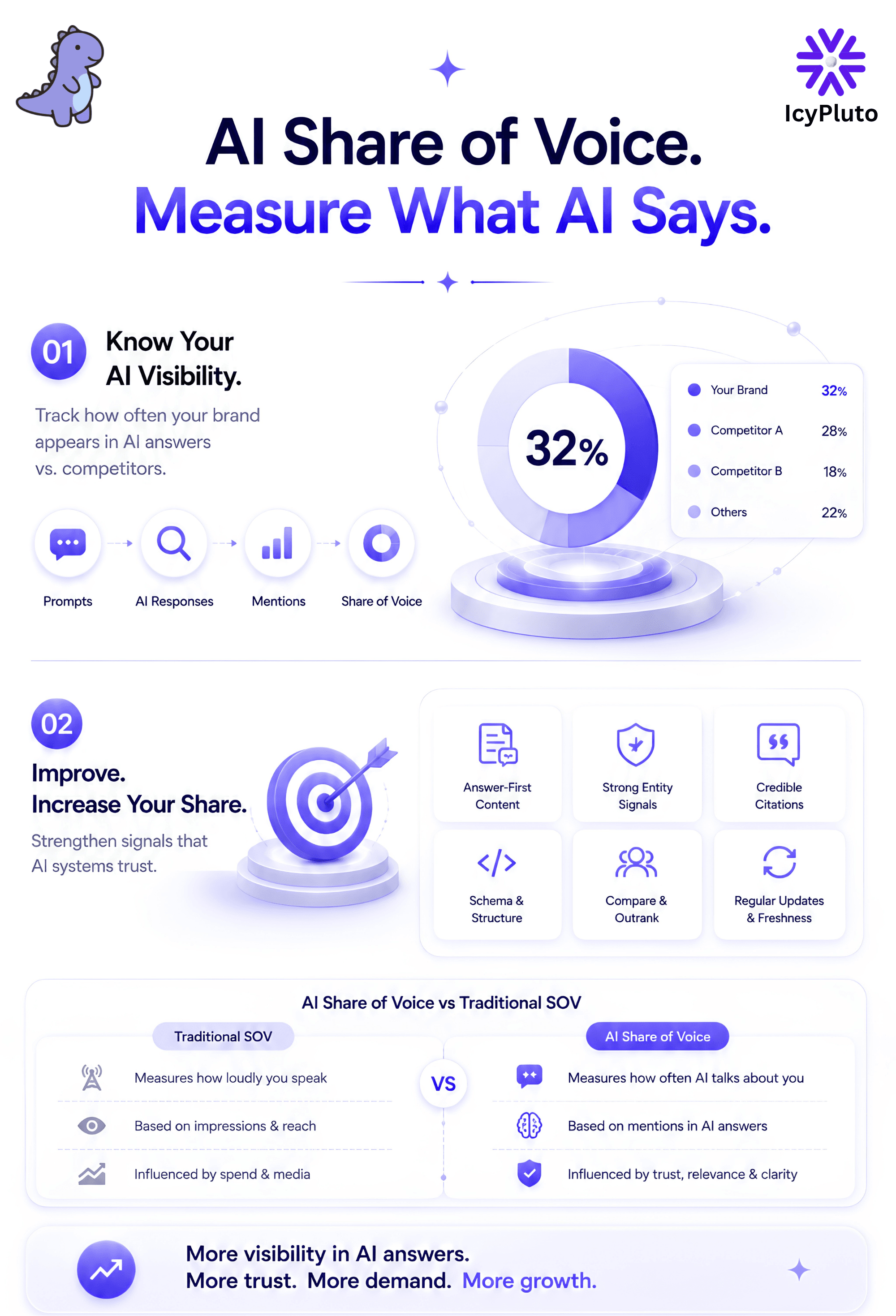
AI share of voice is the new visibility metric bra...
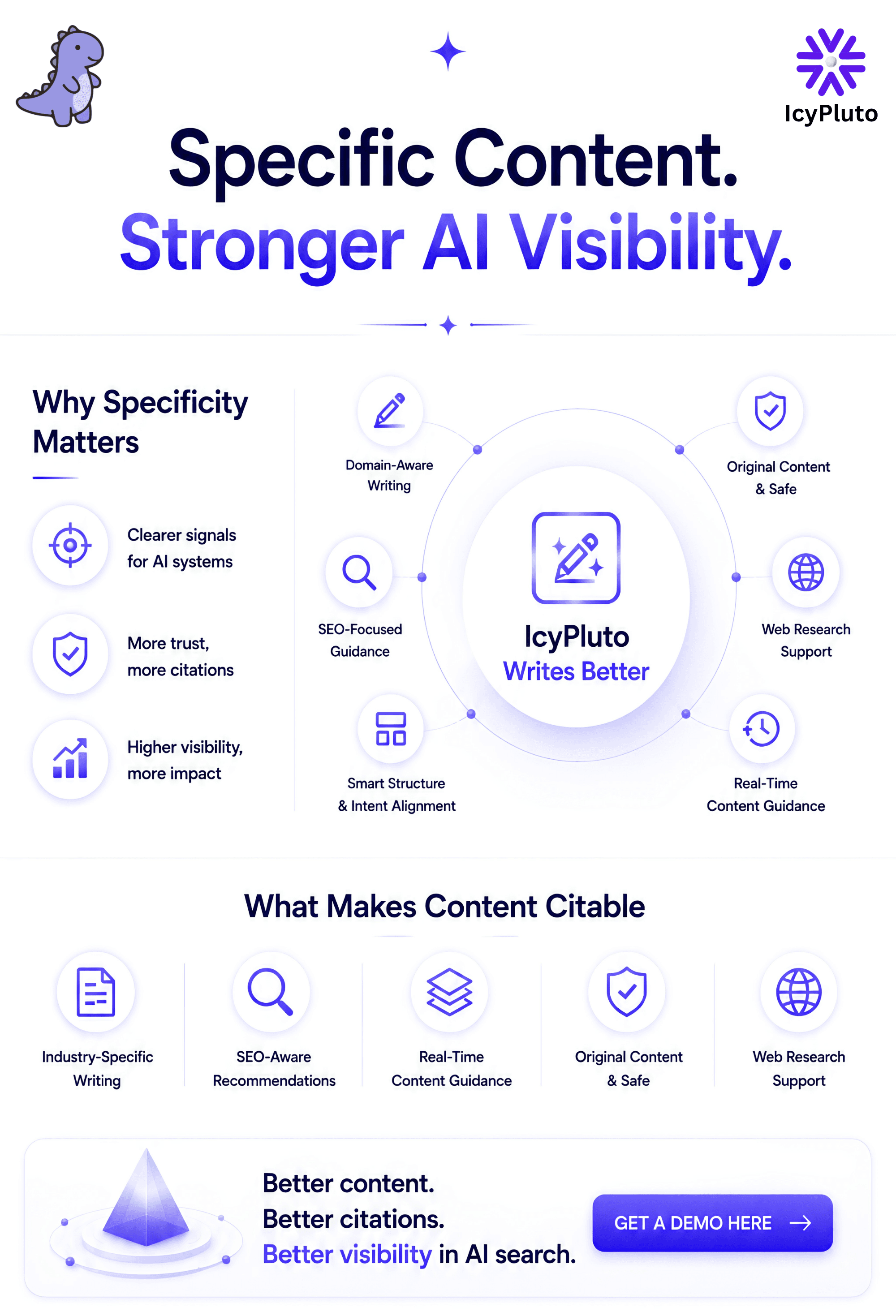
AI SEO writing is getting more specific, and that ...
The rules of digital visibility have shifted — quietly but decisively. Ranking #1 on Google is no longer enough to guarantee that your brand gets discovered. With ChatGPT surpassing 900 million weekly active users and Google AI Overviews now appearing in roughly one out of every four search results, a new battleground has emerged: Generative Engine Optimization (GEO).
If your brand isn't being cited, referenced, or recommended by AI-powered search engines, you are effectively invisible to an enormous and rapidly growing segment of your audience. The good news? Most brands haven't figured this out yet. The window to establish an early-mover advantage is wide open — but it won't stay that way for long.
At IcyPluto, where COSMOS operates as the world's first AI CMO, understanding the intersection of AI and marketing strategy isn't just a talking point — it's the core of everything we do. This playbook breaks down five battle-tested GEO strategies that will help your brand become the go-to recommendation across every major AI search platform in 2026.
Generative Engine Optimization — or GEO — refers to the practice of optimizing your brand's entire online presence so that AI-powered engines actively cite, reference, and recommend you when users ask questions in your industry. Think of it as the AI-era evolution of traditional SEO.
The shift is happening faster than most marketers realize. When a user types a query into ChatGPT, Perplexity, or Google's AI-powered search, the engine doesn't just return a list of links. It synthesizes information from multiple sources and delivers a direct, conversational answer — often citing specific brands, tools, or service providers by name. Those citations drive clicks, trust, and conversions.
Here's what makes GEO fundamentally different from traditional SEO: you're not just competing for rankings anymore — you're competing to become a source. AI engines decide who to trust based on content quality, topical authority, community presence, and structured data signals. And unlike Google's algorithm updates that roll out gradually, AI model updates can shift citation patterns almost overnight.
The brands that understand this dynamic today will be the ones AI engines default to recommending tomorrow. The ones that don't? They'll keep wondering why their traffic is slowly bleeding out despite maintaining strong traditional rankings.
The most common mistake brands make when approaching GEO is jumping straight into content creation without first understanding where they currently stand. You cannot optimize what you haven't measured — and AI visibility is no exception.
Before restructuring your website, rewriting your blog posts, or building new content clusters, you need clear answers to a few fundamental questions: Which AI platforms are mentioning your brand? For which queries? How often are your competitors showing up in the answers where you should be?
The process is more straightforward than it sounds. Start by listing 10 to 15 questions your ideal customer would ask an AI engine. These should be realistic, conversational queries like "best AI marketing tools for small businesses" or "how to automate brand content with AI." Then, manually run each of those queries across ChatGPT, Perplexity, and Google Gemini.
As you go through each response, track the following:
Is your brand mentioned at all? If not, note which competitors are appearing instead.
Are sources being cited? If yes, which domains are getting referenced?
What kind of content is being pulled? Blog posts, listicles, Reddit threads, product pages?
This exercise alone will surface patterns that most brands completely miss. You may discover that a competitor with lower domain authority than yours is consistently getting cited — simply because their content is structured more clearly or because they appear in community discussions your brand hasn't touched.
This audit shouldn't be a one-time activity. AI-generated answers shift constantly as models update and new content gets indexed. Running this check monthly gives you a real-time pulse on your AI visibility trajectory, so you're always optimizing based on current data rather than assumptions.
The baseline insight from this step is non-negotiable. Without it, every other GEO strategy you implement is a shot in the dark.
Here's where a lot of marketers get confused: they assume GEO and SEO are two separate tracks, and that investing in one means deprioritizing the other. That's a costly misunderstanding.
Traditional search engine rankings are still deeply relevant to GEO performance. AI engines — particularly Google AI Overviews — heavily rely on content that already performs well in organic search. If your page ranks on the first page of Google for a relevant query, there's a significantly higher chance that an AI engine will pull from it when generating a response. The two systems are not competing. They're layered.
This means your foundational SEO practices remain critical:
High-quality, in-depth content that thoroughly covers a topic
A strong backlink profile that signals credibility and domain authority
Clean technical SEO — fast load times, proper indexing, mobile optimization, and no crawl errors
Think of SEO as the infrastructure that makes GEO possible. A brand with weak SEO fundamentals will struggle to earn AI citations no matter how well-optimized their content is for generative engines. But a brand that layers GEO tactics on top of a solid SEO foundation? That's where you start winning on both fronts simultaneously.
At IcyPluto, COSMOS is designed to bridge exactly this gap — combining traditional marketing intelligence with AI-native strategy to ensure brands are visible across every layer of the modern search ecosystem. The AI CMO doesn't treat SEO and GEO as either/or. It treats them as a unified, compounding system.
This is where the real work happens — and where most brands fall short. AI engines are selective about what they cite. The quality, structure, and specificity of your content are the primary factors that determine whether you earn citations or get passed over.
Here's a hard truth: the kind of content that ranks well on Google isn't always the kind of content that gets cited by AI engines. Fluffy, keyword-stuffed paragraphs won't cut it. AI systems are looking for content that is authoritative, structured, and directly answerable.
The first shift you need to make is writing for citability, not just readability. AI engines look for clear, specific claims that are backed by data, expert opinion, or demonstrable expertise. Instead of writing vague overviews like "AI is changing the way businesses market themselves," write direct, citable statements: "Brands that implement GEO alongside traditional SEO see compounding visibility gains across both organic and AI-driven search channels."
Structure your content around real questions your audience is asking. Use clear headers that mirror conversational queries. Include FAQs. Keep paragraphs tight and purposeful. When an AI engine scans a page and finds a direct, well-structured answer to a specific question, that page becomes a prime candidate for citation.
Here are the content formats that AI engines tend to prioritize:
Definitions and explanations — AI engines frequently cite authoritative definitions of terms and concepts
Step-by-step processes — Instructional content with numbered steps is highly citable
Statistics and data points — Specific numbers add credibility and get pulled frequently
Expert opinions — First-person insights from recognized practitioners carry weight
Comparison content — AI engines love side-by-side breakdowns when users ask recommendation questions
Structured data isn't just an SEO tactic — it's a GEO accelerator. Implementing proper schema markup helps AI engines understand not just what your content says, but what it is. FAQ schema signals to AI systems that your page directly answers specific questions. How-To schema tells them your content walks through a process. Organization schema helps AI engines associate your brand correctly in their knowledge base.
If your WordPress site isn't using schema markup yet, this is one of the highest-ROI technical changes you can make right now. Plugins like Yoast SEO and Rank Math make implementation straightforward — but make sure the schema you add accurately reflects your content, or it can backfire.
Topical authority also plays a significant role here. AI engines don't just evaluate individual pages in isolation. They evaluate the depth and coherence of your brand's entire content footprint. Brands that publish scattered, unrelated blog posts across dozens of topics send weak signals. Brands that build comprehensive, interconnected content clusters around a specific subject area send strong signals — and get cited accordingly.
Here's a strategy that catches most marketing teams off guard: AI engines treat Reddit and user-generated content as trusted sources. This isn't a coincidence or a temporary quirk. Reddit's prominence in Google results has been growing for over a year, and AI platforms — particularly Perplexity and ChatGPT — actively pull from Reddit discussions when generating product recommendations, comparisons, and how-to responses.
When someone asks an AI engine "what's the best AI marketing tool for a startup," the response is often assembled from a combination of editorial listicles and Reddit threads. If your brand shows up in those discussions authentically, you increase your chances of being cited in AI-generated recommendations significantly.
The key word there is authentically. Reddit's community-driven culture has zero tolerance for obvious brand promotion. Getting this wrong can actively hurt your reputation. Here's how to approach it correctly:
Step one: Find where your audience is already talking. Search Reddit for your product category, your competitors' names, and the specific problems your brand solves. Identify five to ten active subreddits where these conversations happen regularly. Look for threads structured around questions like "what tools do you use for X" or "looking for recommendations on Y."
Step two: Participate before you promote. Spend at least two to three weeks contributing genuinely to these communities before your brand ever comes up. Answer questions that have nothing to do with your product. Upvote useful posts. Engage in conversations. Reddit users check post histories, and an account that exists only to promote a product gets dismissed immediately.
Step three: When relevant threads do come up, represent your brand honestly. Mention what it excels at, but also acknowledge what it's not designed for. AI engines weigh authentic, nuanced mentions far more heavily than polished promotional copy. The more genuine the recommendation sounds, the more likely it is to end up in an AI-generated response.
Cross-platform UGC matters too. Community mentions on platforms like Quora, niche forums, and industry-specific communities also feed AI citation patterns. A brand that shows up authentically across multiple community platforms builds the kind of distributed credibility that AI engines increasingly reward.
When a user asks an AI engine for a recommendation — "best AI tools for content marketing" or "top platforms for brand automation" — the AI doesn't generate that list from scratch. It synthesizes from existing listicle articles published on authoritative websites that rank well in organic search.
A single well-placed mention in a high-authority "best of" article can get your brand recommended simultaneously across ChatGPT, Perplexity, and Google AI Overviews. That kind of leverage is extraordinary — and it's available to any brand willing to do the outreach work required to earn those placements.
Here's the process:
Identify the listicles AI engines are already citing. Run your core recommendation queries in ChatGPT and Perplexity and document which articles come up repeatedly. These are the exact publications you need to target for inclusion. Prioritize sites with high domain authority that appear consistently across multiple AI platforms.
Prepare your brand for inclusion. Before you reach out to a single publication, make sure your product pages are pitch-ready. This means a sharp, clear one-liner that explains what your brand does, an obvious list of differentiators, visible social proof (testimonials, case studies, user numbers), and transparent pricing. Authors updating listicles need to be able to evaluate you in under two minutes.
Build relationships with authors and editors. Cold outreach works better when you have something valuable to offer. A free account, access to a demo, or original data the author can use in their article are all effective entry points. The goal is to make including your brand the easy, obvious choice.
Listicles are also living documents. Most get updated quarterly or even monthly, which means AI engines regularly re-scan them for new content. A placement you earn today could start generating AI citations within weeks — and that citation momentum compounds over time as more users interact with AI-generated responses that reference your brand.
Every strategy covered in this article points toward the same underlying requirement: your brand needs to be intelligently managed by systems that understand how AI engines evaluate and recommend content. That's not a task that scales well through manual effort alone.
IcyPluto's COSMOS — the world's first AI CMO — is built for exactly this reality. COSMOS doesn't just automate content creation or social scheduling. It operates as a full-stack marketing intelligence system that continuously monitors how your brand is positioned across both traditional search and AI-driven discovery channels. From content strategy and topical authority building to community presence and structured data optimization, COSMOS brings a coherent, AI-native approach to the entire GEO challenge.
In a digital landscape where AI engines are increasingly the first point of contact between a brand and its audience, having an AI CMO that speaks the language of generative search isn't a luxury — it's a competitive necessity. The brands that recognize this today, and act on it with the right tools and strategies, will be the default recommendations AI engines surface tomorrow.
The window is open. GEO is still in its early stages, and most brands haven't even begun to think about it. That means the opportunity to build a dominant AI-search presence — before your competitors even recognize the threat — has never been greater.
The only question is whether you'll move first.