This blog explains why brands are losing visibilit...
Citation seeding is becoming one of the fastest wa...
AI search has turned visibility into a numbers gam...
If you have been in SEO long enough, you know the drill. You receive 10 or more LinkedIn messages daily from link-building agencies promising you a guaranteed number of links. They offer link swaps and generic outreach that feels more like spam than genuine connection-building.
This approach is not just annoying. It is fundamentally wrong.
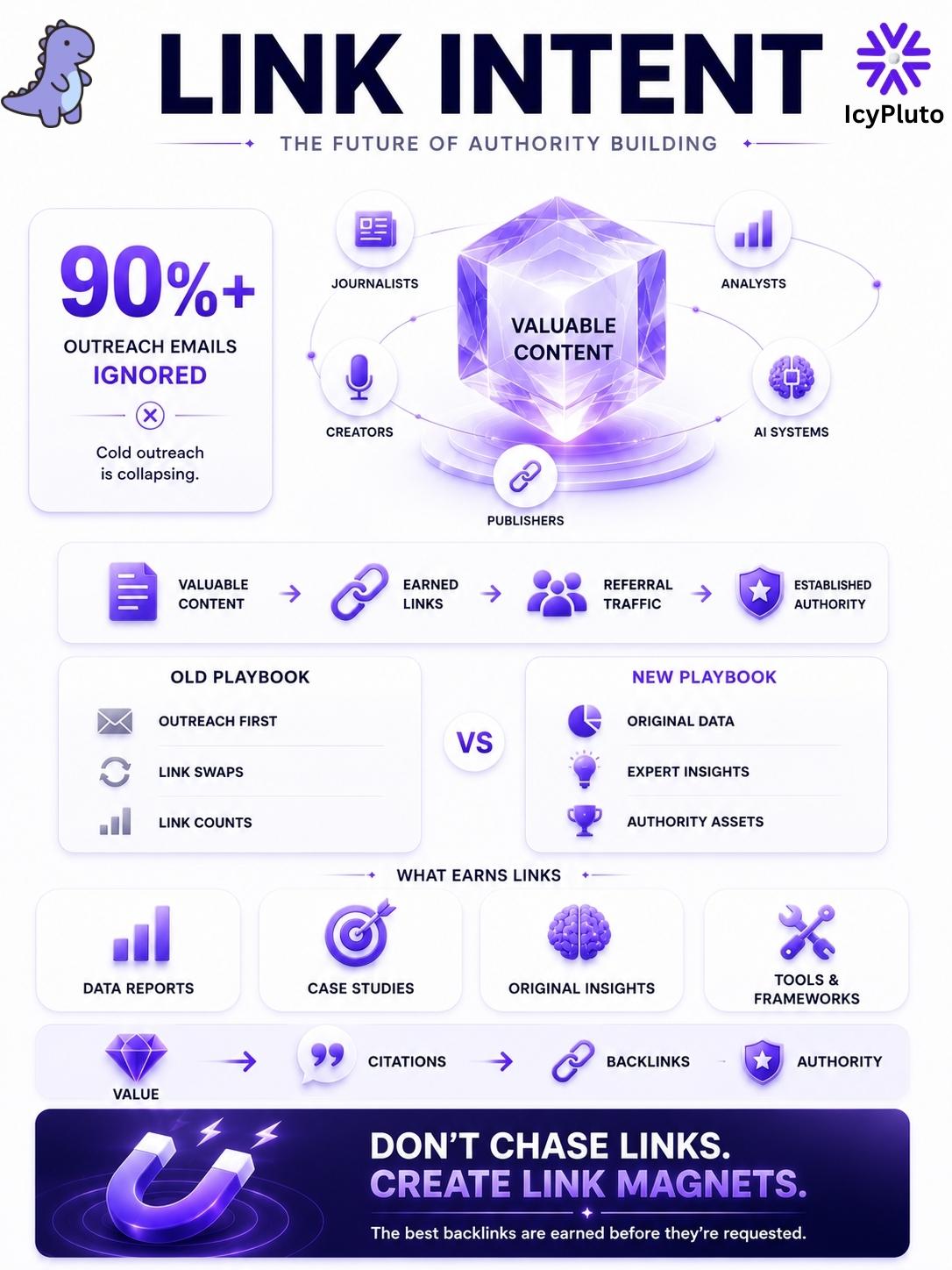
The better way to build links is to create content that naturally generates them. I call this writing content with link intent. It combines authoritative, valuable content with strategic outreach that comes at the end, not the beginning.
This approach is more effective, more evergreen, and more efficient than siloed content and link building initiatives. It also burnishes your brand's reputation instead of damaging it.
Link building and content creation should be part of the same process. Yet in my experience, this integration is rare. Most teams treat them as separate initiatives, which leads to a critical mistake: optimizing for links alone without regard for down-funnel effects.
Instead of starting with a link count goal, start by thinking about who in your community cares about what you are writing. Think about who should care and why.
Content generated from this mindset has a far better chance of passively gaining links over time. When you write strong, relevant content that makes people want to share it, and you have provided genuine value, the links will come naturally. You will not need to send spammy emails or InMails to get them.
If you are working in content and link building silos, your resources are likely working toward a goal number of links while asking for link swaps. This strategy tends to ignore whether the content being pushed is actually relevant or useful. It also ignores whether it would reflect well on your brand, which is the opposite of what good content should achieve.
Content written with a nod toward Google's helpful content guidelines provides real value and is geared toward user experience. This type of content actually appeals to the people who write about the same concepts and are looking for fellow experts to validate their positions.
When you produce content good enough to contribute to a topic's discourse, it will attract links. Google will come to recognize its relevance naturally. This is a much deeper and more integrated approach than chasing sheer link building numbers.
AI is sure to have fundamental ripple effects in SEO. AI results are appearing in SERPs, and AI-produced content from other publishers is increasing competition. But I am predicting that the importance of establishing authority will not be diminished. If anything, it will become more vital.
Delivering signals of authority and value will be more important than ever. As long as organizations and individuals are still publishing content, backlinks will remain an important part of establishing that authority.
The data supports this. According to 2026 SEO statistics, 68 percent of online experiences begin with a search engine. Google accounts for 63.41 percent of all US web traffic referrals. SEO drives measurable business results, with every $1 invested returning an average of $7.48 over a 3-year period according to Terakeet and Search Engine Journal.
But here is what many SEOs miss. Content good enough to generate passive links gives you a great chance of getting shared and driving referral traffic, which is generally undervalued in SEO. Valuable content produced with link intent will naturally drive links and equity over time, producing a built-in snowball effect.
This does more than save you time with link outreach. It ideally creates a network of related sites and publishers for referral traffic that can provide tons of value over time. Think of it as an organic version of affiliate marketing, which is a huge channel gathering steam in 2026.
I can confidently say that I have won several clients for my agency thanks to the content I have written. Chances are that many B2B businesses can make similar claims. The content itself becomes the business development tool.
Let us be honest about what is happening with traditional link building outreach. The average cold outreach reply rate in 2026 is 3.43 percent according to Instantly's platform-wide benchmark across billions of emails. This is down from 7 percent in 2023 and 8.5 percent in 2019.
The gap between elite and average campaigns is enormous. Top quartile campaigns hit 5.5 percent or higher. Elite campaigns in the top 1 percent exceed 10 percent. But link-building-specific digital PR averages 13 percent according to Hunter.io, which is multiple times ahead of generic sales cold email.[linkbuildingjournal.co]
For generic cold sales email, the 2026 benchmark is 3.43 percent. For link-building-specific digital PR, Hunter.io reports a 13 percent average reply rate. The classic 8.5 percent Backlinko figure represents a strong outreach campaign in 2026, closer to top quartile than to average.[bloggerspassion]
Only 8.5 percent of link-building outreach emails get a response, which means over 90 percent of website owners ignore outreach emails. When you send one more follow-up email, the response rate increases to 14.1 percent. That is a 65.8 percent boost in replies just by following up once.[bloggerspassion]
When the subject line is personalized, the response rate is 21.8 percent. Without personalization, the response rate is only 16.7 percent. Wednesday has the highest average response rate for outreach emails at 7.64 percent, while Saturday performs worst with just 5.65 percent.[bloggerspassion]
These numbers explain why the old link building tactics are becoming irrelevant. The response rates are collapsing, and the teams that succeed are the ones that create genuinely valuable content worth linking to in the first place.
Ready for a checklist to get you on your way? You will notice an outreach component, but it comes near the end after the heavy lifting of relevance is done. This is the key difference from traditional link building.
Start by researching keywords where bloggers and journalists are actively searching for references. These keywords often include words like statistics or reports. When people search for these terms, they are looking for data and sources to cite in their own content.
Use Reddit, Quora, Twitter, Ahrefs Matching terms report, and Exploding Topics among your references. These platforms will show you what questions people are asking and what information they cannot find easily.
For example, if you notice multiple people asking for 2026 SEO statistics on Reddit, that is a clear signal that journalists and bloggers are looking for updated data in that space.
From those keywords, build a list of topics around which your team can share valuable insights and perspectives. Do not just compile existing data. Add your own unique analysis, expert opinions, and contemporary insights.
Find expert resources either internal or closely connected to your organization. Interview them for resources to build a cache of content. This gives you authentic authority and unique perspectives that competitors cannot easily replicate.
Refine and develop that content into contemporary insights using Google Trends and social listening. Use timing and a list of audience modifiers to heighten relevance.
Here is a concrete example. Get a list of tips from an expert targeted to help hay fever sufferers, which is your niche audience modifier. Focus on helping them get a better night's sleep, which is your core topic and target. Time the content during a particularly bad high pollen count period, which is your relevance trigger.
This combination of niche audience, core topic, and timing makes your content far more linkable than generic evergreen content.
Research a list of writers and journalists who cover those topics. Look for people who have written about similar concepts recently. Check what sources they cited in their articles.
These are the people most likely to link to your content if it provides genuine value. They are already covering the topic, which means they are actively looking for sources and references.
Pitch a group of writers and journalists who cover your theme and subtheme. Focus on why this matters right now and how it is different from other content they might find to reference.
Your pitch should answer three critical questions. Why does this matter today specifically? What is different about your content compared to what they have seen before? How will their readers benefit from linking to or citing your content?
If writers and journalists link to your content, follow them on their social channels to deepen your connection for future opportunities. Even before they link to your content, start building relationships by engaging with their work.
Does this approach actually work? Consider Todoist, the productivity app that has built massive authority through link intent.
Todoist's unique presentation of productivity methods has generated hundreds of referring domains. The number has grown 50 percent year over year and contributed mightily to the brand's overall growth. This is not from spammy outreach or link swaps. This is from creating genuinely useful content that people naturally want to reference.
Todoist presents productivity methods in a unique way that makes their content linkable. They do not just write about productivity. They create frameworks, visual presentations, and practical systems that bloggers, journalists, and other content creators want to cite as authoritative sources.
If you are wondering whether backlinks still matter in 2026, the answer is yes, but they are no longer the golden ticket they used to be. Search engines now analyze semantic context, not just link quantity. It is not that you have a backlink. It is why, from whom, and in what context.
According to 2026 SEO analysis, here are the five organic ranking factors that matter more than traditional backlink building:
Topical authority is about becoming the go-to source on a specific subject. If your website publishes deep, well-researched, interconnected content on a topic and keeps it updated, search engines begin to view your site as an authority. This does not just improve rankings for a single page. It lifts your entire domain's visibility.[linkedin]
E-E-A-T, which stands for Experience, Expertise, Authoritativeness, and Trustworthiness, is now the foundation of SEO success. In 2026, E-E-A-T best practices focus on showing real experience, expertise, authority, and trust through original, transparent content that helps your site stand out. Google rewards quality signals with higher rankings.[whoopit.co]
Unlinked brand mentions function like soft backlinks and boost your topical credibility. In 2026, you do not need a hyperlink to get SEO credit. If your brand is mentioned by name in trustworthy sources including blogs, social media, YouTube videos, and newsletters, AI picks up on it.[linkedin]
Referral traffic from quality links matters more than link count. The average conversion rate from organic traffic is 2.4 percent, compared to 1.3 percent for paid traffic and 0.7 percent for social according to FirstPageSage 2026. Traffic is only useful when it converts to leads for your sales team, making conversion rate optimization an important element of successful campaigns.[firstpagesage]
User experience and content quality are now the primary drivers of rankings. In 2026, rankings are driven by E-E-A-T and content that genuinely helps users, not just keywords. Google's latest updates are clear: quality and intent matter more than ever.[instagram]
Not all content is created equal when it comes to earning links. The content types that attract natural links include data-backed reports, industry research, visual assets like infographics and charts, case studies, ultimate guides, and tools, templates, and checklists.
If your content teaches, solves, or simplifies, people naturally link to it. This is the fundamental principle behind link intent.
AI makes it easy to compile industry statistics and create data reports. Publish original data, even small insights. A 2026 Packaging Design Trends Report, an Indian FMCG Buying Behaviour Survey, or Top SEO Tools Usage Statistics in 2026 can all work. Journalists, bloggers, and industry writers love linking to data sources.[linkedin]
Build brand authority across platforms. Modern backlinks often come from brand presence, not direct outreach. Focus on consistent publishing on LinkedIn, expert posts on Medium and Quora, short video insights on Instagram, YouTube, and TikTok, and participation in niche communities like Reddit and Product Hunt. When your brand becomes top of mind, backlinks happen naturally.[linkedin]
Refresh old and outdated content on the web. This is the Skyscraper 2.0 version for 2026. Instead of stealing links, help creators update outdated information. Write to them saying you noticed their article mentioned stats from 2021, and you recently published updated 2026 insights that they can use if helpful. This strategy builds natural editorial links with zero spamming.[linkedin]
Turn customer stories into case studies. People love sharing success stories. Add before and after results, data, screenshots, and client testimonials. Clients often cross-share the case study, giving you organic backlinks.[linkedin]
Conduct collaborative content partnerships. Create content with others rather than for yourself through joint webinars, co-branded newsletters, expert roundups, podcasts, and interview articles. Each partner naturally links back from their platforms.[linkedin]
Build backlinks through events and webinars. When you host or speak at events, the event page links to you. Attendees blog about you. Press releases mention you. Social posts tag you. This creates brand-based, natural backlinks.[linkedin]
When you produce content with link intent, you create something that compounds over time. Each piece of quality content becomes a node in a growing network of related sites and publishers.
This network effect is what makes link intent so powerful. The first piece of content might earn 10 links. The second piece might earn 15 links as people who linked to your first piece discover your second. The third piece might earn 25 links as your authority grows.
This is the snowball effect that valuable content produces naturally. It saves you time with link outreach because you are not starting from zero every time. You are building on existing relationships and authority.
Think about it as an organic version of affiliate marketing. Instead of paying commissions for referrals, you are earning referrals through value. The ROI is infinitely better because the marginal cost of each additional link approaches zero as your content library grows.
Talking to many SEOs these days, I notice they put less emphasis on link building than they did years ago. In my opinion, this is less about links losing importance than it is about old link building tactics becoming irrelevant.
A link-intent approach combining great content with strategic outreach is more effective, evergreen, and efficient than siloed content and link initiatives. It works now, and it will continue working as AI and search evolve.
Why is it future-proof? Because it is built on fundamental principles that will not change. People will always want to link to content that provides genuine value. Writers will always need sources to validate their positions. Journalists will always look for expert insights to cite.
Generic link building tactics will continue becoming less effective as response rates collapse and search engines get better at detecting manipulation. But content that genuinely helps users will always earn links, referral traffic, and authority.
Link intent also burnishes your brand's reputation at the same time it drives incremental traffic. This influences your users' experience for the better. People who discover your content through referrals already trust the source that linked to you. This pre-qualified trust makes conversion more likely.
IcyPluto applies link intent by creating content that is built to earn attention first and links second. The focus is on original insights, niche relevance, expert-backed narratives, and high-utility assets that publishers, bloggers, and AI systems are more likely to reference naturally. Instead of chasing random backlinks, the team starts by identifying topics where people actively need credible sources, then turns those insights into content pieces that are timely, useful, and easy to cite.
The outreach comes after the value is created. Once the content is strong enough to stand on its own, IcyPluto maps the right journalists, creators, websites, and industry communities that already cover similar themes. From there, the promotion is personalized, relevant, and built around why the content matters now. This helps brands earn stronger backlinks, better referral traffic, more authority signals, and greater visibility across AI search experiences where trust, relevance, and brand depth increasingly shape what gets surfaced.
If you are tired of receiving spammy link building pitches and want to build links that actually matter, shift your mindset. Stop thinking about link building as a separate initiative. Start thinking about content creation as the foundation for authority building.
Research keywords where writers need references. Build topics around your team's unique insights. Refine content with timing and audience modifiers. Identify writers who cover your themes. Pitch with relevance and differentiation.
Most importantly, create content that is good enough to earn links passively. Content that contributes to topic discourse. Content that helps users. Content that reflects well on your brand.
The links will follow. The referral traffic will follow. The business results will follow.
This is link intent. It is the future of authoritative content marketing in the age of AI search. And it starts with creating value first, asking for links second.