
AI share of voice is the new visibility metric bra...

This blog explains why traditional, traffic-focuse...

This blog explores how IcyPluto’s Action Feature h...
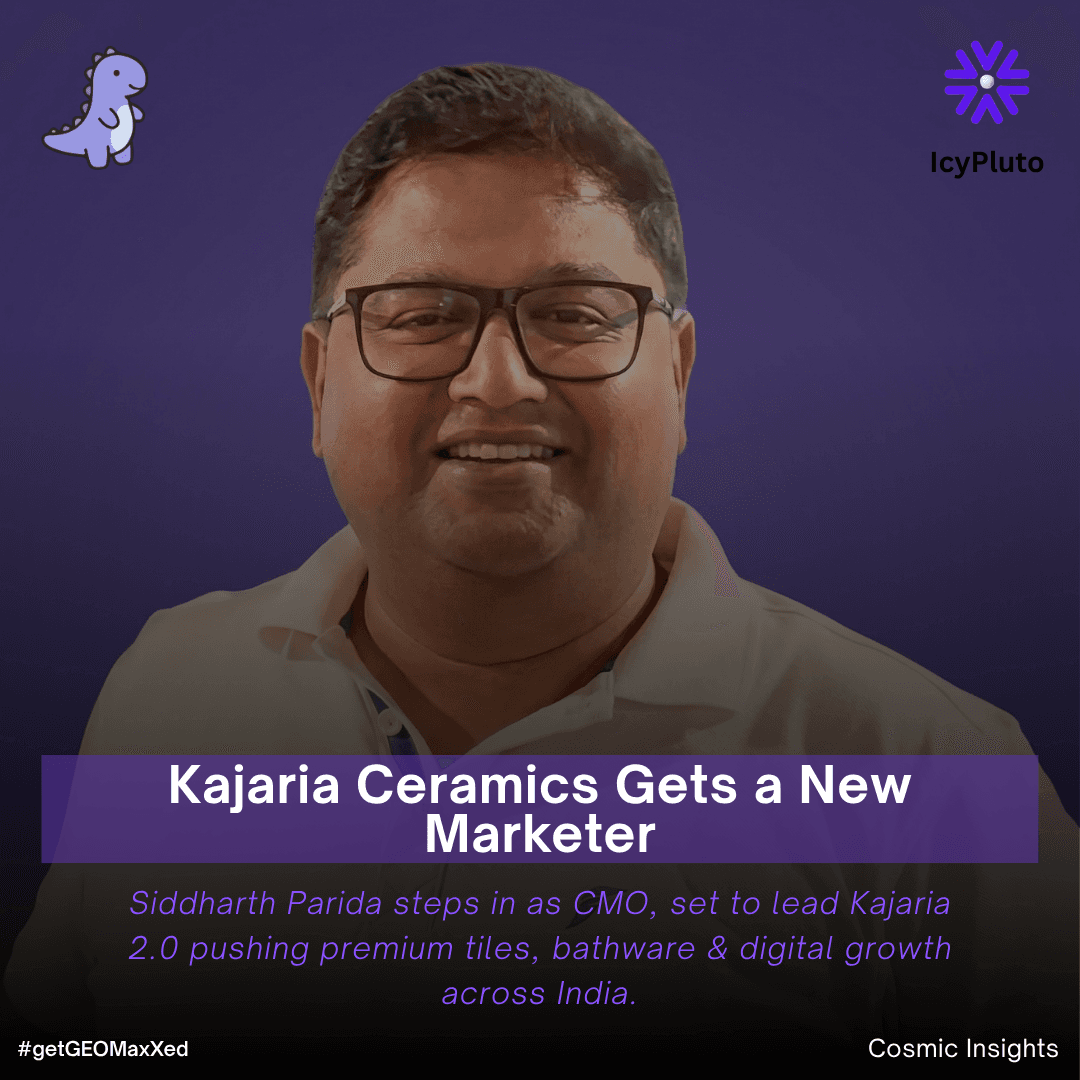
India's tiles and home surfaces industry just witnessed a marquee leadership move. Kajaria Ceramics Limited — the country's largest manufacturer of ceramic and vitrified tiles — has appointed Siddharth Parida as its new Chief Marketing Officer (CMO), effective March 25, 2026. The appointment was cleared by the Board of Directors through a circular resolution passed on March 23, 2026, cementing Parida's entry into one of the most prominent marketing roles in India's building materials sector.
This appointment isn't just a routine executive shuffle. It signals Kajaria's intent to aggressively push its premium identity, elevate digital consumer touchpoints, and widen its leadership across tiles, bathware, and sanitaryware — all under the ambitious "Kajaria 2.0" strategic framework. For a company that already commands a dominant share of India's tiles market with operations spanning nine manufacturing plants across India and Nepal, this move is a calculated bet on transformational brand leadership.
At IcyPluto, where we track the intersection of CMO-level leadership and AI-driven brand strategy, appointments like Parida's deserve a deep and contextual lens. Here's everything you need to know.
Siddharth Parida steps into the CMO role after serving as Head of Marketing – India at The Goodyear Tire & Rubber Company, where he contributed significantly to APAC-level strategy, drove brand premiumization efforts, and accelerated revenue growth for one of the world's most recognized tire brands. His work at Goodyear was not just regional — it had a clear macro-strategic dimension, preparing him well for the scale and complexity of India's ceramics and home improvement market.
But what makes this hire stand out is the breadth of transformation Parida has already led across sectors. Long before Goodyear, he served as Head of Brand & Digital at Birla Opus, where he architected the strategic market entry of the Aditya Birla Group's paints business — a launch that disrupted an industry long dominated by Asian Paints and Berger. Orchestrating an entirely new brand in a fiercely competitive category is no small feat, and Parida pulled it off with precision.
One of the most telling decisions in corporate hiring is when a legacy brand in a traditional category looks beyond its own industry for leadership talent. Kajaria's choice of Parida — a marketer with roots in FMCG, media, automotive, and tech — is deliberate and forward-looking.
The ceramics and tiles industry has historically relied on distribution-first strategies and dealer loyalty programs. The next phase of growth, however, demands consumer-first brand building, digital ecosystem development, and aspirational positioning — all of which are Parida's core competencies. His cross-sector playbook brings a freshness that category insiders often lack, making him a natural fit for the Kajaria 2.0 agenda.
Siddharth Parida's professional journey reads like a masterclass in institutional brand building. Spanning two decades across some of India's most respected corporations, his career reflects a pattern of walking into complex brand challenges and delivering transformative outcomes.
One of the most prominent chapters in Parida's career was his six-year tenure at Tata Sky, during which he anchored one of corporate India's most high-profile rebranding exercises — the transition of Tata Sky to Tata Play. This wasn't merely a logo change or a name swap. It was a comprehensive identity overhaul that required realigning customer perception, dealer communication, advertising strategy, and digital presence simultaneously across India's massively diverse markets.
The success of the Tata Play rebrand is a testament to Parida's ability to manage multi-stakeholder brand transitions without disrupting business continuity — a skill that will be directly applicable as Kajaria accelerates its own premiumization narrative under the 2.0 strategy.
Before the high-profile corporate rebrands, Parida developed his core marketing instincts in categories that are arguably the most demanding in India — paints and dairy. His stints at Asian Paints and Amul (GCMMF) gave him a foundational understanding of mass-market consumer behavior, category management, and integrated media strategy.
Amul, in particular, is a brand that operates at a scale and complexity that few global companies can match — managing consumer perception across hundreds of SKUs, price-sensitive rural markets, and competitive urban segments all at once. This early immersion into high-stakes, high-volume marketing shaped Parida's ability to think big while executing at the ground level.
What sets Parida apart from many traditional CMOs is his early-career grounding at Infosys, which gave him a technology-first perspective that most consumer marketers never develop. In an era where brands are increasingly driven by data, automation, and AI-powered personalization, a CMO who understands how technology infrastructure shapes consumer experience holds a distinct edge. This background will be invaluable as Kajaria looks to enhance its digital consumer ecosystem — one of the three core pillars of the Kajaria 2.0 blueprint.
To fully appreciate the weight of Parida's mandate, it's essential to understand what Kajaria 2.0 actually means for the company. Kajaria Ceramics, established in 1988, is more than just India's largest tile maker — it's a brand that has spent decades building a reputation for quality, design variety, and pan-India distribution.
With a market capitalization of approximately ₹140 billion, nine manufacturing plants, and a tile production capacity of 87.80 million square meters (MSM), the company is already operating at a formidable scale. But the Kajaria 2.0 vision pushes beyond scale. It is fundamentally a premiumization and differentiation strategy aimed at repositioning Kajaria as a design-led, aspirational brand rather than just a category leader defined by volume.
The Kajaria 2.0 framework is built on four interconnected pillars that Parida will be expected to drive from the marketing front:
Premiumization of core products — Elevating the perceived value of tiles, adhesives, and bathware through product design, storytelling, and brand experience.
Operational consolidation and subsidiary integration — Streamlining the portfolio to ensure brand coherence across Kajaria's multiple product verticals.
Selective geographic expansion — Intensifying focus on tier-2 and tier-3 domestic markets, where the next wave of housing and renovation demand is expected to originate.
Digital consumer ecosystem enhancement — Building a more seamless, data-driven, and personalized consumer journey from discovery to purchase.
The company has already made bold moves on the celebrity marketing front. A recent high-profile campaign featuring Ranveer Singh and Rashmika Mandanna was launched to "unify Kajaria's tiles and bathware under one narrative" — a clear signal that brand-level integration across product categories is already underway. Parida's arrival as CMO adds the strategic marketing muscle needed to sustain and scale this momentum.
The appointment of a CMO with Parida's profile at Kajaria Ceramics has implications that extend well beyond the company itself. It reflects a broader transformation happening across India's building materials and home improvement sector, where brands are increasingly competing on identity and aspiration rather than just product specification and price.
India's tiles and sanitaryware market is undergoing a structural upgrade. Post-pandemic housing demand, the rise of nuclear families, and an aspirational middle class with greater design consciousness are collectively driving consumers toward premium home surfaces. Kajaria has been ahead of this curve with its UniTerra luxury tiles brand and its Kerovit bathware line, both of which represent the kind of high-margin, design-forward products that benefit most from sophisticated brand marketing.
Parida's mandate to lead national marketing strategy across tiles, bathware, and sanitaryware simultaneously puts him at the center of this premiumization wave. His challenge will be to craft a brand narrative that feels aspirational and cohesive — one that connects a first-time homebuyer choosing floor tiles in Lucknow with a premium apartment developer specifying large-format slabs in Mumbai.
Perhaps the most future-critical part of Parida's mandate is enhancing Kajaria's digital consumer ecosystem. In a category traditionally driven by showroom visits and dealer recommendations, the shift toward digital discovery, virtual room visualization tools, and e-commerce-influenced purchase decisions is still in early stages — but accelerating rapidly.
Parida's background in digital strategy, particularly from his time at Birla Opus where he managed the digital dimensions of a full-scale brand launch, positions him well to architect a consumer digital journey that transforms how buyers interact with and ultimately choose Kajaria products. This includes leveraging social media, influencer ecosystems, immersive visualization platforms, and eventually, AI-driven personalization tools.
At IcyPluto, the world's first AI CMO platform developed under the COSMOS framework, we have been closely monitoring how senior marketing appointments are reshaping brand strategies across categories. Siddharth Parida's move to Kajaria is emblematic of a broader trend — brands are no longer just hiring marketers; they are hiring strategic architects who can bridge technology, consumer insight, and brand vision simultaneously.
The skill set that makes Parida an ideal CMO for Kajaria 2.0 — cross-industry agility, digital-first thinking, large-scale brand transformation experience, and a foundation in technology — mirrors exactly the kind of human intelligence that AI marketing tools like IcyPluto's COSMOS platform are designed to augment and amplify.
As AI continues to reshape how brands create content, personalize messaging, and analyze consumer behavior, CMOs who combine deep domain knowledge with technological fluency will increasingly define competitive advantage. Parida's trajectory, from Infosys to FMCG giants to automotive to now India's largest tiles brand, is a blueprint for the modern, AI-ready CMO.
The ceramics sector, historically perceived as slow-moving in marketing innovation, is about to get a significant upgrade. And with Kajaria's scale and Parida's pedigree, the industry will be watching this story unfold with great interest.
Siddharth Parida's appointment as CMO at Kajaria Ceramics is more than a leadership transition — it's a strategic statement about where one of India's most iconic brands is headed. With a 20-year career that includes rebranding Tata Sky into Tata Play, launching Birla Opus from the ground up, and driving premiumization at Goodyear, Parida brings exactly the kind of transformational marketing DNA that the Kajaria 2.0 vision demands.
As India's home improvement market continues to premiumize and digitize, the next chapter for Kajaria Ceramics — under Parida's marketing leadership — promises to be one of the most closely watched brand stories in the country.