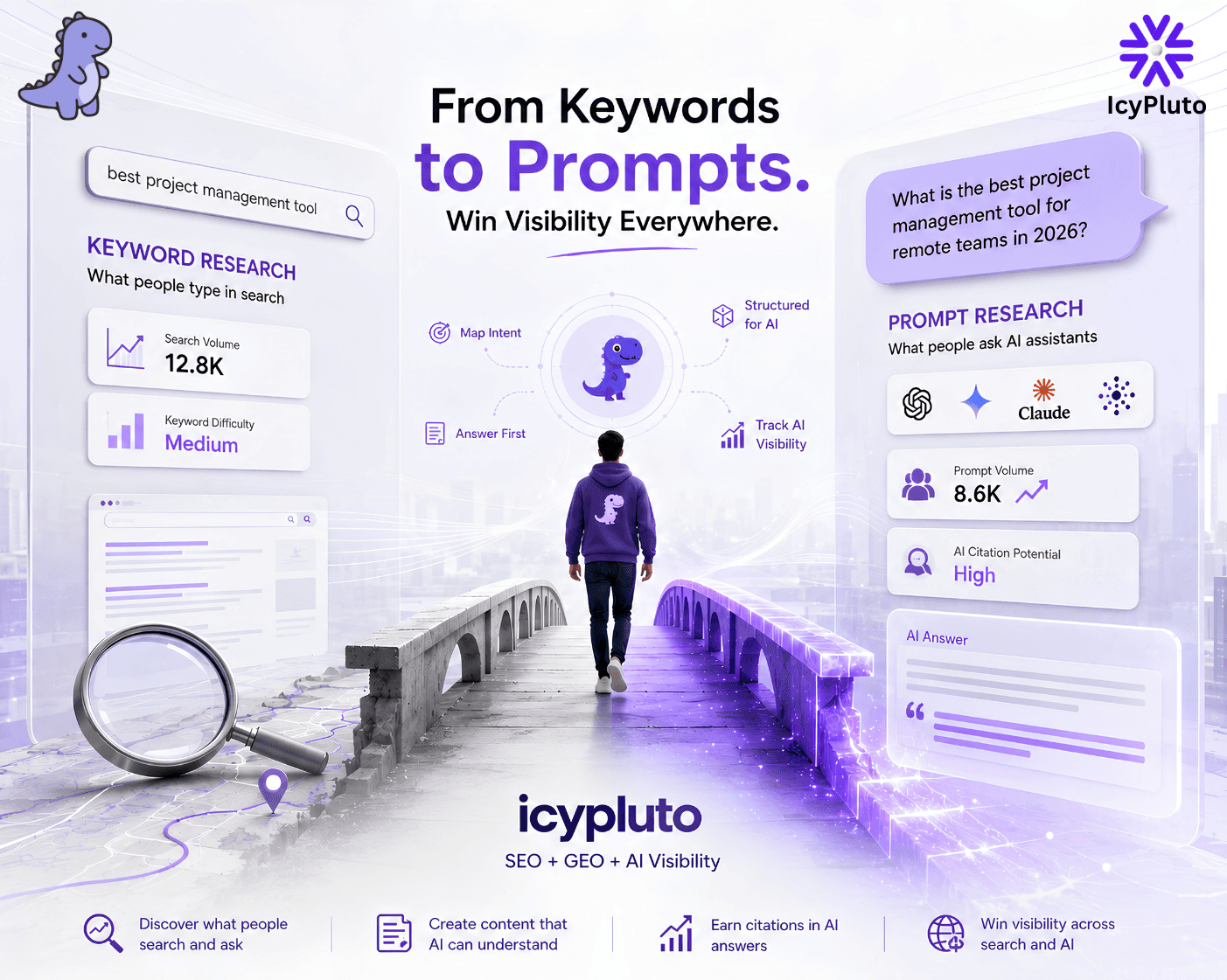
This blog explains how keyword research must now b...
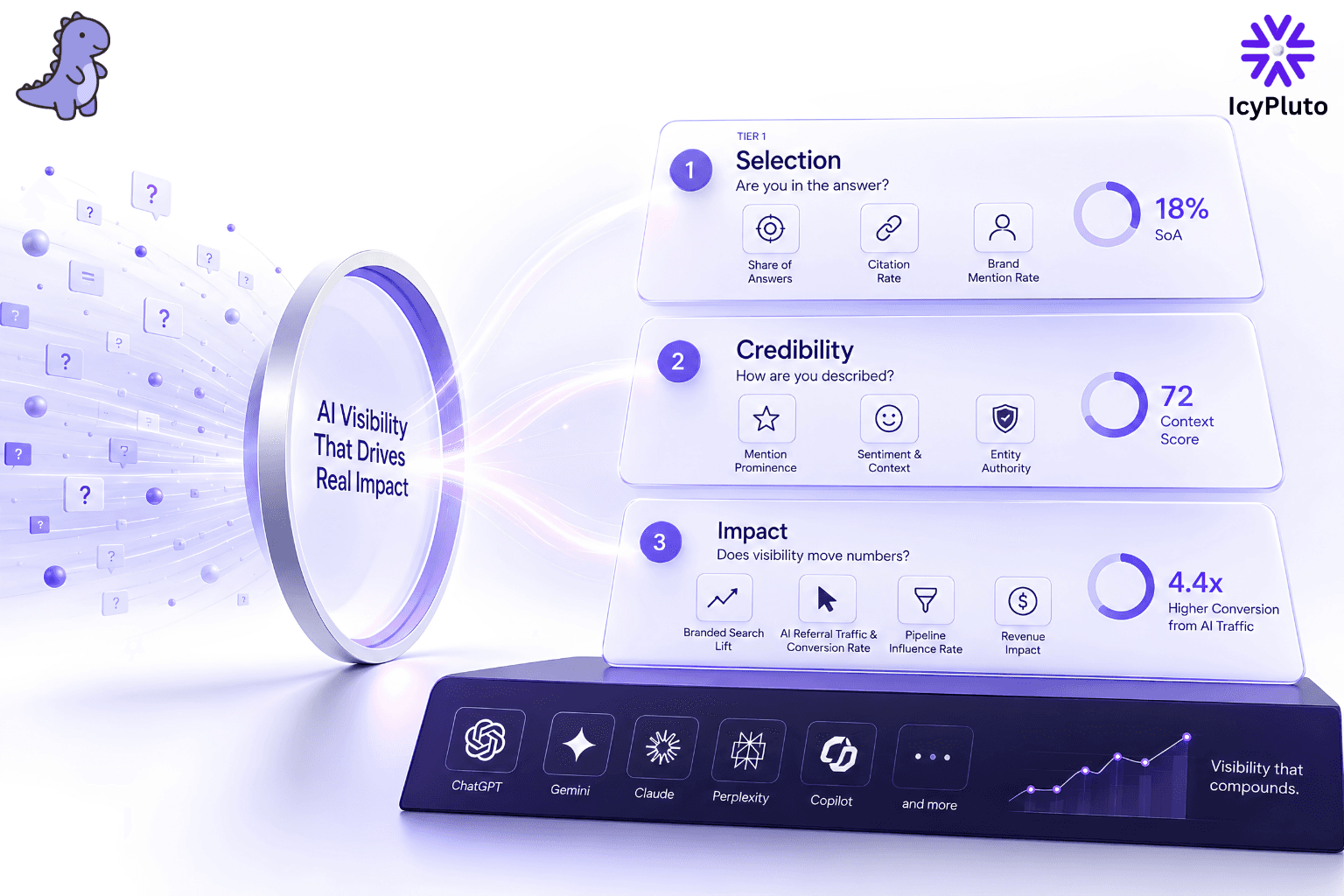
AI search has turned visibility into a numbers gam...
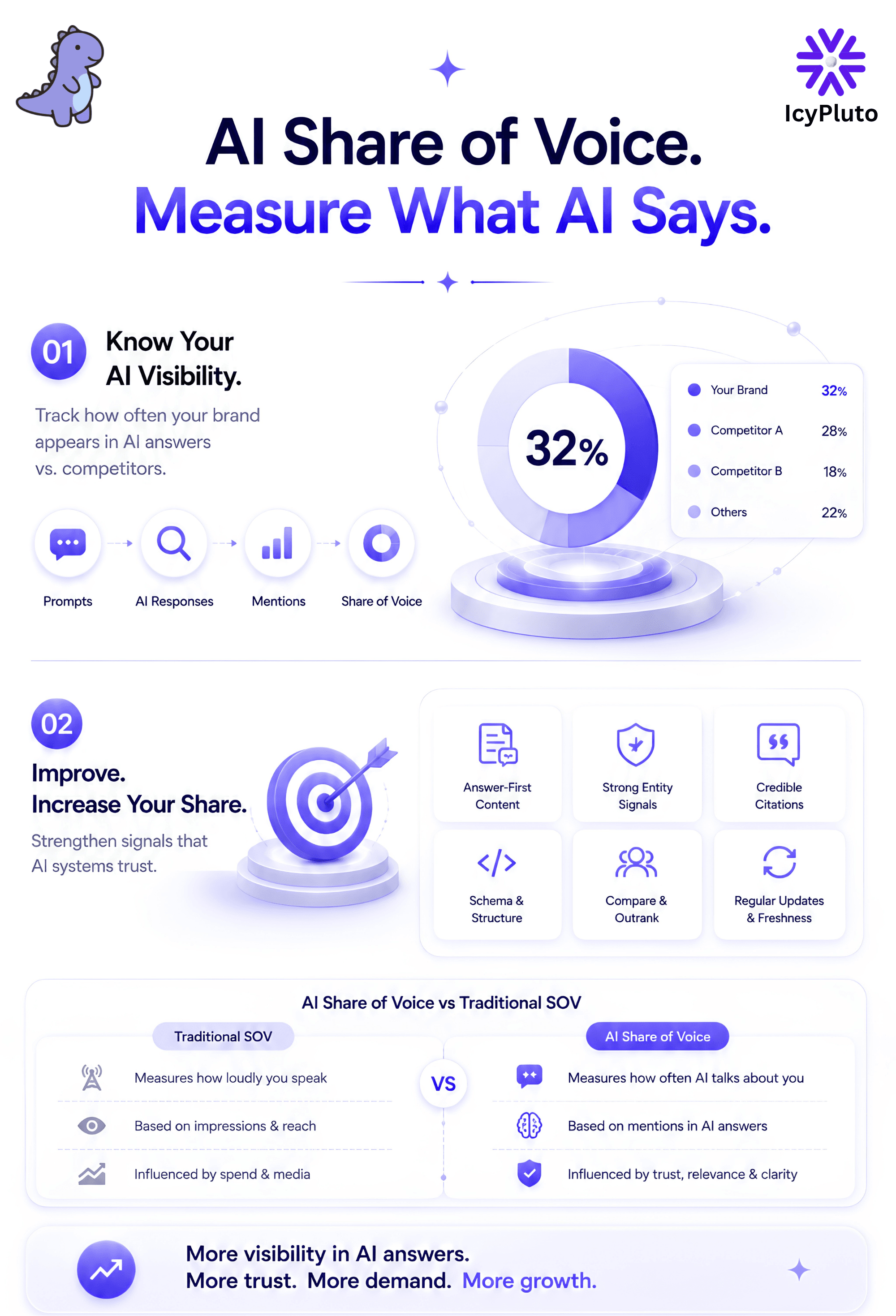
AI share of voice is the new visibility metric bra...
The AI search revolution is no longer coming — it has arrived. Across boardrooms, marketing war rooms, and agency pitches alike, one question keeps surfacing with growing urgency: "What's our AI search plan?" But at IcyPluto, we believe that's the wrong question to be starting with. Before you scatter your budget and rewrite your entire GEO roadmap to "be everywhere AI is," there's a far more strategic question that deserves your attention first — which Large Language Model is actually driving conversions for your specific brand or client?
This is not a drill. AI-driven referral traffic is now converting at 14.2% compared to just 2.8% for traditional Google organic search — that's five times higher. Yet most brands are still treating all LLM platforms as equal channels, spreading their optimization efforts thin across ChatGPT, Perplexity, Gemini, and Claude without any performance-driven rationale. The era of blindly chasing AI visibility is over. The era of precision GEO has begun — and IcyPluto is here to walk you through exactly what that looks like.
The instinct to optimize across every LLM platform simultaneously feels proactive, even responsible. But in practice, it dilutes effort and inflates costs without guaranteeing returns. The reason is simple: not every LLM platform behaves the same way, attracts the same user intent, or generates the same quality of traffic for every industry vertical.
AI search is experiencing explosive growth right now — with over 1.13 billion AI referral visits recorded recently, marking a staggering 357% year-over-year jump. That kind of volume might tempt any marketer into wanting to cast the widest net possible. But raw traffic numbers are not the metric that matters. What matters is conversion quality — and that varies dramatically from one LLM to another, and from one industry to another.
LLM-driven traffic, while currently accounting for roughly 2.2% of total website visits, delivers 3.5 times higher conversion rates compared to most other traffic channels. This tells a compelling story: AI users come with higher intent. When an LLM recommends your brand or service, the user has often already done their mental filtering. They're not browsing — they're deciding. The only question left is: which platform is sending those high-intent users to your category?
Every agency and in-house team has a finite budget. Treating ChatGPT, Perplexity, and Gemini as identical investment vehicles — without industry-specific conversion data to back the decision — is the equivalent of running billboard ads in three different cities without knowing which city has your customers. The dollars might feel spread evenly, but the returns will be wildly uneven.
At IcyPluto, our analysis suggests that brands who implement platform-specific GEO strategies based on actual conversion data consistently outperform those who optimize generically across all AI channels. This isn't speculation — it mirrors broader market data showing that brands cited in AI Overviews alone receive 35% more organic clicks, while the remaining traffic converts 23 times better than average. The signal is clear: being selectively excellent at AI visibility beats being broadly average.
ChatGPT remains the most widely recognized name in consumer AI, and its sheer user base makes it an important consideration for nearly any B2C or B2B brand. It excels in creative text generation, complex multi-turn conversations, and nuanced content understanding. For industries where storytelling, persuasion, and relationship-building drive conversions — think SaaS, education, consulting, and e-commerce — ChatGPT's referral traffic can be particularly valuable.
A critical insight from the data: 87% of ChatGPT citations correspond to top Bing results. This means your Bing SEO performance directly influences whether ChatGPT recommends your brand. If you've been neglecting Bing as part of your SEO strategy — which many SEO professionals have — you may be inadvertently reducing your ChatGPT citation chances. For brands targeting ChatGPT visibility, investing in Bing-specific technical SEO, structured data, and authoritative backlinking becomes non-negotiable.
Perplexity AI is carving out a distinctly different user base: researchers, analysts, professionals, and highly informed buyers who want cited, verifiable answers rather than conversational responses. It pulls live information from the web and attributes sources in real-time, making it the go-to tool for users who want depth and accuracy over fluency.
For industries like healthcare, finance, legal services, technology, and B2B services — where credibility and accuracy are deal-breakers — Perplexity's traffic can represent an exceptionally high-quality pipeline. Users arriving from Perplexity have typically already validated your brand through citations and source comparisons, meaning they arrive with a level of trust pre-established that most other channels simply cannot replicate. Perplexity is also noted for significantly lower hallucination rates since every response is grounded in sourced content, further reinforcing the trust signal it carries.
Gemini has been the dark horse in this race, and by early 2026 it is no longer just catching up — it is actively outperforming ChatGPT in benchmarks for reasoning and coding tasks, with traffic and usage continuing to climb. Backed by Google's ecosystem and deeply integrated with Search, Maps, Workspace, and Android, Gemini occupies a unique position that no other LLM can replicate.
For brands operating in the Google ecosystem — local businesses, Google Ads-heavy advertisers, YouTube-centric brands, and mobile-first companies — Gemini's AI-driven recommendations can have direct, measurable impact on search visibility and conversion. Its multimodal capabilities, which include image, audio, and video understanding, make it particularly relevant for industries with rich visual or multimedia product experiences. Brands that already perform well in traditional Google Search are likely the best positioned to win Gemini citations, given the strong overlap between Google's organic ranking signals and Gemini's reference layer.
To understand why LLM traffic converts so much more effectively than traditional organic traffic, you need to understand the behavioral shift happening at the user level. When someone searches Google for "best CRM software," they get a list of links and must do their own research. When that same person asks ChatGPT or Perplexity the same question, the AI does the comparison work for them, synthesizes the options, and often provides a recommendation — and possibly a direct link.
By the time the user clicks through to your website from an LLM response, the consideration phase is largely complete. They're not arriving to evaluate — they're arriving to convert. This is why the 14.2% LLM conversion rate dwarfs the 2.8% Google organic rate. It's not that LLM users are different people — it's that the AI has done the top-of-funnel and mid-funnel work on your behalf, delivering users directly to the decision stage.
This is where IcyPluto's analysis gets granular, and where most generic GEO guides miss the mark entirely. Conversion rates from specific LLM platforms are not uniform across industries. A legal services firm may find that Perplexity drives the highest-quality leads because its research-oriented users are seeking authoritative, cited information before making high-stakes decisions. An e-commerce brand selling consumer electronics might find ChatGPT driving stronger purchase-intent traffic because of its conversational product recommendation format. A local service business might see Gemini delivering the most valuable conversions due to its deep integration with Google's local ecosystem.
The only way to know which LLM is performing for your specific category is to track it. This requires implementing UTM parameters specifically for AI referral traffic, setting up channel-specific attribution in your analytics dashboard, and mapping AI traffic sources to actual goal completions or revenue events. Without this data infrastructure, you're operating blind in a market that is moving at AI speed.
IcyPluto recommends a structured approach to GEO prioritization that starts with data, not assumptions. The framework operates in three phases: Audit, Attribute, and Accelerate.
In the Audit phase, conduct a comprehensive scan of how your brand currently appears across ChatGPT, Perplexity, and Gemini. Search your brand name, key products or services, and category-specific queries. Document where you appear, where you don't, and how competitors are represented. This establishes your AI visibility baseline and immediately surfaces gaps that need addressing.
In the Attribute phase, set up LLM-specific tracking to connect AI referral visits to actual business outcomes. This means configuring your analytics to distinguish between AI search referrals and standard organic traffic, creating custom conversion tracking for AI-sourced visitors, and building a reporting model that shows revenue, lead quality, and customer lifetime value by LLM source. This phase is often where the most valuable strategic insights emerge — and it's precisely what separates performance-driven GEO from vanity-metric GEO.
In the Accelerate phase, you take the data from your attribution work and double down on the platforms that are genuinely converting for your industry. If Perplexity is delivering high-intent B2B leads, you invest in making your brand more citable: updating authoritative content, earning mentions from credible third-party sources, implementing structured data, and ensuring your expertise signals (E-E-A-T) are strong across the web. If ChatGPT is your highest converter, you focus on Bing SEO and building the kind of comprehensive, well-structured content that ChatGPT's models favor.
One of the most actionable and often overlooked elements of a strong GEO strategy is technical schema implementation. AI systems don't just crawl text — they interpret structured information signals to decide which brands, products, and services to surface and recommend. By implementing schema markup for your organization, products, FAQs, reviews, and how-to content, you make it significantly easier for LLMs to accurately understand, represent, and recommend your brand.
At IcyPluto, our technical approach to GEO always begins with a schema audit. Brands that have clean, accurate, and comprehensive structured data are demonstrably more likely to earn AI citations. This is especially true for Perplexity, which relies heavily on sourced, verifiable information, and for Gemini, which leverages Google's structured data processing infrastructure. If your website isn't speaking the language that AI systems understand at a technical level, you're leaving citation opportunities on the table regardless of how good your content is.
One of the most practical challenges in AI search marketing is demonstrating its value to clients or internal stakeholders in a language they understand: revenue and return. The vagueness of "AI visibility" as a metric has led many decision-makers to deprioritize GEO investment — not because it doesn't work, but because no one has shown them the data in a compelling, credible format.
The solution is a conversion-anchored reporting model that maps AI search activity to real business outcomes at every stage of the funnel. This model should track: AI referral sessions by source platform, goal completion rates from AI traffic, average order value or lead quality scores for AI-sourced customers, revenue attribution by LLM channel, and trend data showing how AI-driven performance evolves over time. When clients can see that Perplexity-sourced leads are closing at twice the rate of standard organic leads, the conversation shifts from "should we invest in GEO?" to "how much should we scale this?"
At IcyPluto, we position AI visibility not as a branding exercise but as a measurable growth lever. Our reporting frameworks are built around proving causality — not just correlation — between AI search presence and downstream business outcomes. This approach allows brands to justify every dollar of GEO investment, scale what works, and cut what doesn't with confidence rather than guesswork.
The brands winning in AI search right now share one common trait: they stopped treating LLM optimization as a monolithic task and started treating it as a multi-platform, data-driven performance discipline. They know which LLM matters most in their vertical. They know what content format that platform prefers. And they know — with attribution data to back it up — what a cited mention in that platform's responses is actually worth in revenue terms. That is the standard IcyPluto holds GEO strategy to, and it is the standard the entire industry is rapidly moving toward.
The AI search landscape in 2026 is no longer a novelty or an emerging trend — it is a primary growth channel with measurable, trackable, and scalable performance metrics. The question is no longer whether to invest in AI visibility, but where to invest, how much, and with what specific strategy per platform based on real conversion data.
IcyPluto's core takeaway from this entire analysis is straightforward: precision beats coverage. Understanding exactly which LLM is driving real value for your industry — and then concentrating your GEO effort there with the right content structure, technical implementation, and attribution tracking — will consistently outperform a spray-and-pray approach across all platforms simultaneously. The data is available. The frameworks exist. The only thing standing between most brands and AI search ROI is the decision to stop guessing and start measuring.
Brands cited in AI Overviews are already receiving 35% more organic clicks, and the remaining traffic converts 23 times better than average. The compounding advantage of strong LLM visibility is real, and it is building week by week. The brands that move now — with strategy and data behind them — will establish citation authority that becomes increasingly difficult for late movers to unseat.