AI share of voice is the new visibility metric bra...
This blog explains why brands are losing visibilit...
Citation seeding is becoming one of the fastest wa...
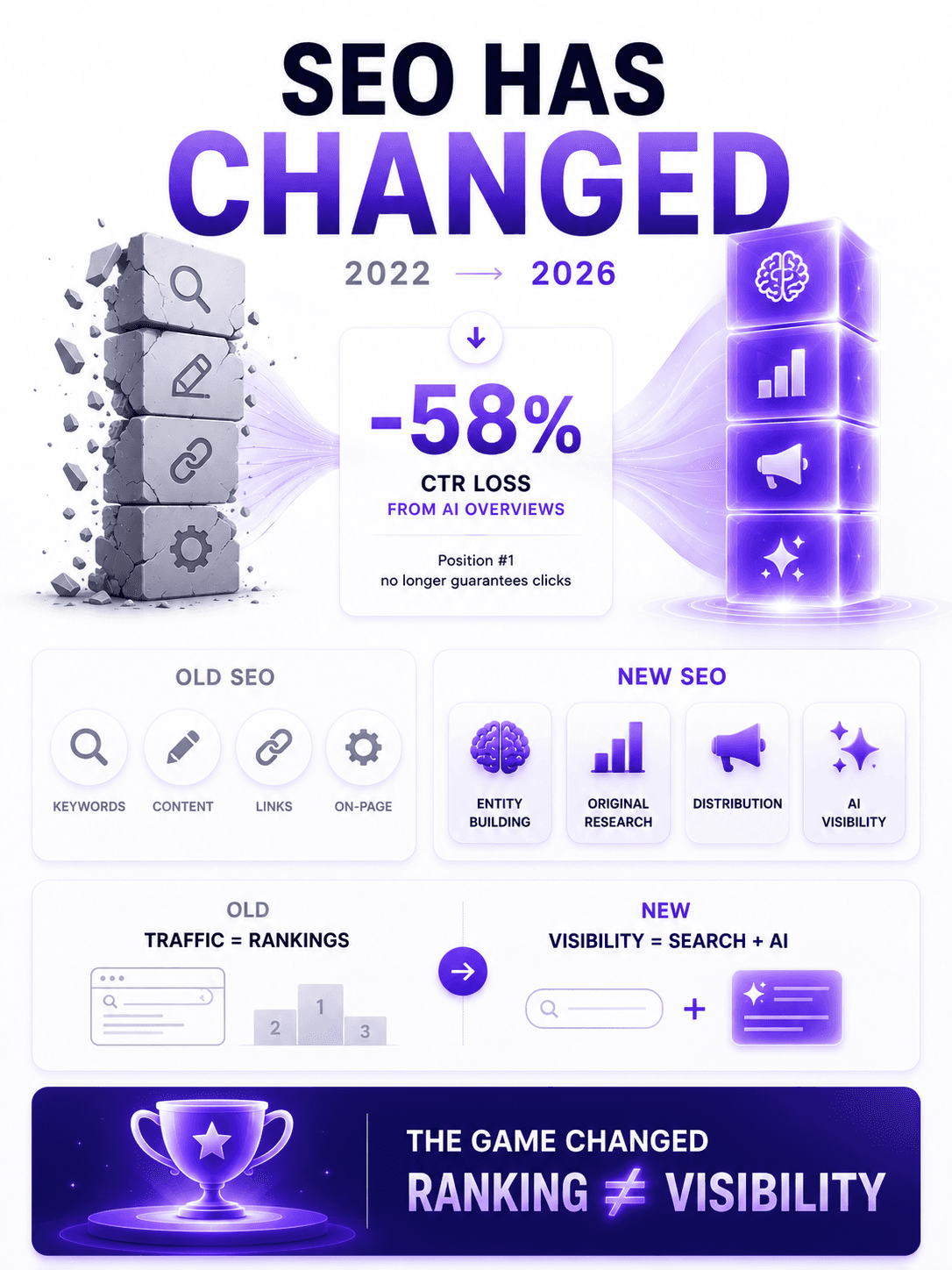
The job description for SEO hasn't changed much in five years. Whether you work in-house or at an agency, most SEO roles still revolve around the same core tasks: keyword research, on-page optimization, technical audits, content briefs, link building, and reporting. Maybe some conversion rate optimization if the person writing the job description was feeling ambitious.
The problem is that all these skills no longer add up to work that moves the needle.
I have spent the last 18 months watching this play out across client bases. The work that drives results in 2026 looks almost nothing like the work that drove results in 2022. Yet team structures, training plans, and retainers are still built around the old model. Both in-house leaders and agency owners are quietly wondering why their teams feel busy but ineffective.
The honest answer is that a meaningful chunk of what they are being asked to do is not the whole picture anymore. This is not about AI killing SEO. It is about what the discipline has become and what your team needs to do to win at it.
Three things have quietly fallen off the list of activities worth paying for at the volume we used to.
Producing a list of 200 keywords with search volumes and difficulty scores used to be billable work. It still appears on retainers. But the strategic value of that output has collapsed. Volume data is increasingly unreliable now that AI Overviews are absorbing top-of-funnel queries. Difficulty scores never accounted for SERP feature crowding anyway. The keywords that convert sit in long-tail territory that no tool surfaces well. Keyword research as a thinking activity still matters. As a packaged deliverable, it does not.
The old model was simple: identify keyword gaps, brief them out, publish at pace, and watch traffic grow. That model is broken in two places at once. AI Overviews are eating the informational queries those articles used to capture. The cost of producing competent but undifferentiated content has fallen to almost zero. Producing more of it does not move you ahead of anyone. If your content could have been generated by anyone using the same prompt, ranking for it is increasingly difficult and increasingly worthless.
Adding internal links, tweaking title tags, and optimizing H1s. All of this still matters, and skipping it will cost you. But it is the floor, not the strategy. Doing it well gets you to the point where your content has a fair chance of being judged on its merits. It does not, on its own, get you ranking. Teams that spend 40 percent of their week on on-page work and treat that as the job are doing the necessary part and skipping the bit that drives growth.
None of this means the fundamentals do not matter. They absolutely do. Solid technical SEO, well-optimized pages, and properly briefed content are still the foundation on which everything else sits. Skip them, and nothing further up the stack will work. The big change is that the fundamentals used to be most of the job. Now they are the starting point. Everything above the foundation relies on those foundations being in place, but the foundations alone will not get you ranking the way they used to.
Most teams have the bottom layer broadly under control and very little going on above it. This is why the work feels busy but the results do not move.
The data shows something dramatic is happening. As of December 2025, AI Overviews reduce the organic click-through rate for position one content by 58 percent according to Ahrefs research. For every 100 clicks you could historically earn for a top-ranking page, Google now keeps 58.[ahrefs]
This is corroborated by other research. Seer Interactive found organic CTR down between 49.4 percent to 65.2 percent. Kevin Indig reported over 50 percent decline. Authoritas measured 47.5 percent. The Daily Mail reported 80 to 90 percent lower CTR. Regardless of your feelings about AI Overviews, it seems categorically true that they siphon away the majority of clicks once available to top-ranking pages.[ahrefs]
For queries where AI Overviews appear, organic CTR dropped 61 percent. For queries with an AI Overview present, the zero-click rate hits 80 to 83 percent. Zero-click search is the new normal.[velacore]
This means 58.5 percent of searches are zero-click as of 2026. Only 14 percent of marketers track AI visibility. Being cited within an AI Overview can drive brand visibility, voice-search authority, and assisted conversions, even without a direct visit.[goodfirms]
Here is what I would put on a job description today, in rough order of how often the lack of it shows up as the actual reason a client is not growing. The execution changes by business size, but the underlying skill is the same.
This is the single biggest gap I see across our client base. Google has been moving toward entity-based understanding for years, and the rise of LLM-driven search has accelerated it. If your brand is not recognized as a known entity in your space, you are competing with one hand tied behind your back, regardless of how good your content is.
For larger teams, the skill is owning a program that earns the brand and its senior people visibility across the web. It is part SEO, part PR, part communications, and it sits awkwardly between functions in most organizations. Someone needs to be accountable for it, with the remit to work with the press team, the content team, and the founder or senior leadership.
For smaller businesses, the skill is closer to disciplined consistency. Someone needs to own whether the business shows up accurately and coherently wherever it gets mentioned, and whether anyone outside the immediate customer base has any reason to know it exists. That is a different job from keyword work, and it rarely gets assigned. We have one client in the engineering sector where most of the last year has gone on exactly this kind of work, and their non-branded visibility has roughly doubled in that period.
Either way, the capability gap is the same. Very few teams have anyone whose actual job is to build the brand as a recognized entity. It is increasingly what decides whether the rest of the SEO work pays off.
If you can publish data, insight, or experience that does not exist anywhere else, you have something AI cannot synthesize and competitors cannot easily copy. Experience is genuinely the most defensible differentiator left in the discipline.
For larger teams, the skill is being able to scope, run, and publish original research at a level journalists will pick up. That is a small cluster of disciplines: research design, analysis, editorial, and outreach. It is almost never found in its entirety within an SEO team. Building or partnering into that capability is the next hiring frontier for any business serious about earning links and citations at scale.
For smaller businesses, the skill is editorial, not research. You almost certainly have years of hands-on expertise, real client outcomes, and a working knowledge of your sector that nobody else has lived through. The capability that determines whether any of that reaches an audience is having someone who can extract genuine expertise from those who have it and turn it into publishable content.
That is something most small businesses do not currently have, and what most agencies are not currently selling. It is the gap that decides whether their content reads like everyone else's or like something only they could have written.
The old assumption was that good content would earn links naturally if it was good enough. That was never quite true, and it is certainly not true now. Content gets cited, linked to, and quoted because someone actively put it in front of the right people.
For larger teams, the skill set has merged most visibly with PR, and it is where most teams are weakest. The capability needed is a hybrid of SEO judgment and PR craft. The realistic options are either bringing the two functions closer together, hiring across both, or partnering with someone who already does it well.
For smaller businesses, the skill is closer to relationship building than media relations. You do not need a press contact list, but you do need someone who treats getting your work in front of the right people as part of their job, not something that happens by accident. That is a fundamentally different mindset from waiting for content to be discovered, and it is the bit most small businesses are missing.
Regardless of size, the underlying capability is the same: someone whose explicit job is to make sure good content reaches the people it was written for. Most teams do not have anyone who owns this, and it shows.
This is the noisiest part of the discipline right now, and most of the noise is unhelpful. The real signal is that how your brand shows up in AI Overviews, ChatGPT, Perplexity, Claude, and the rest is now a measurable, optimizable thing. It does not always correlate with how you rank in traditional search.
For larger teams, the skill is partly old: structured content, semantic markup, and entity work. It is partly new: understanding how different LLMs retrieve and cite content, tracking brand mentions inside AI responses, and designing content that earns citations rather than clicks. Someone needs to own it and have the time and tooling to track it properly.
One app client was a useful example of why. Their attribution gaps had been masking the fact that a significant chunk of new traffic was coming via AI-driven discovery, not via paid or organic channels as the dashboard was reporting. Without someone tracking that, the whole picture was off.
For smaller businesses, the skill is more about curiosity than tooling. Whoever owns marketing needs to regularly ask whether the business shows up when prospects ask AI tools about its sector, and if not, why not. Most small businesses do not have anyone asking the question at all.
What both ends of the market are getting wrong is treating AI visibility as a separate channel. It is not. It is the downstream consequence of the rest of the stack being in good shape. The teams winning here do not have the most sophisticated LLM tracking. They are the ones with strong entity signals, genuine expertise visible across the web, and someone paying attention to whether any of it is showing up where it needs to.
The reporting tier of SEO has been commoditized for years. Anyone can pull a Search Console export and put it in a dashboard. What still has scarcity value is being able to interpret that data, which is harder than it sounds when half your traffic signals are now distorted by AI Overviews swallowing clicks, branded search inflating because of LLM exposure, and attribution becoming more fragmented by the month.
For larger teams, the skill is closer to analyst than marketer. Someone who can sit with messy data, cross-reference it across platforms, and produce a view of what is driving growth rather than what looks tidy on a slide. That capability is underhired in both in-house and agency settings. It is increasingly the difference between a team that can defend its strategy in a board meeting and one that cannot.
For smaller businesses, the budget for a dedicated analyst usually is not there, but the skill still applies in a lighter form. Whoever owns marketing needs to be able to interpret the numbers and be honest about which traditional metrics have become misleading. What matters most is curiosity about the gap between what the analytics suggest and what is happening commercially, and the willingness to act on what that gap reveals.
First-party data will become increasingly important in all cases. Tracking incoming leads, speaking with customers, and gaining a better understanding of the customer journey become almost impossible without it.
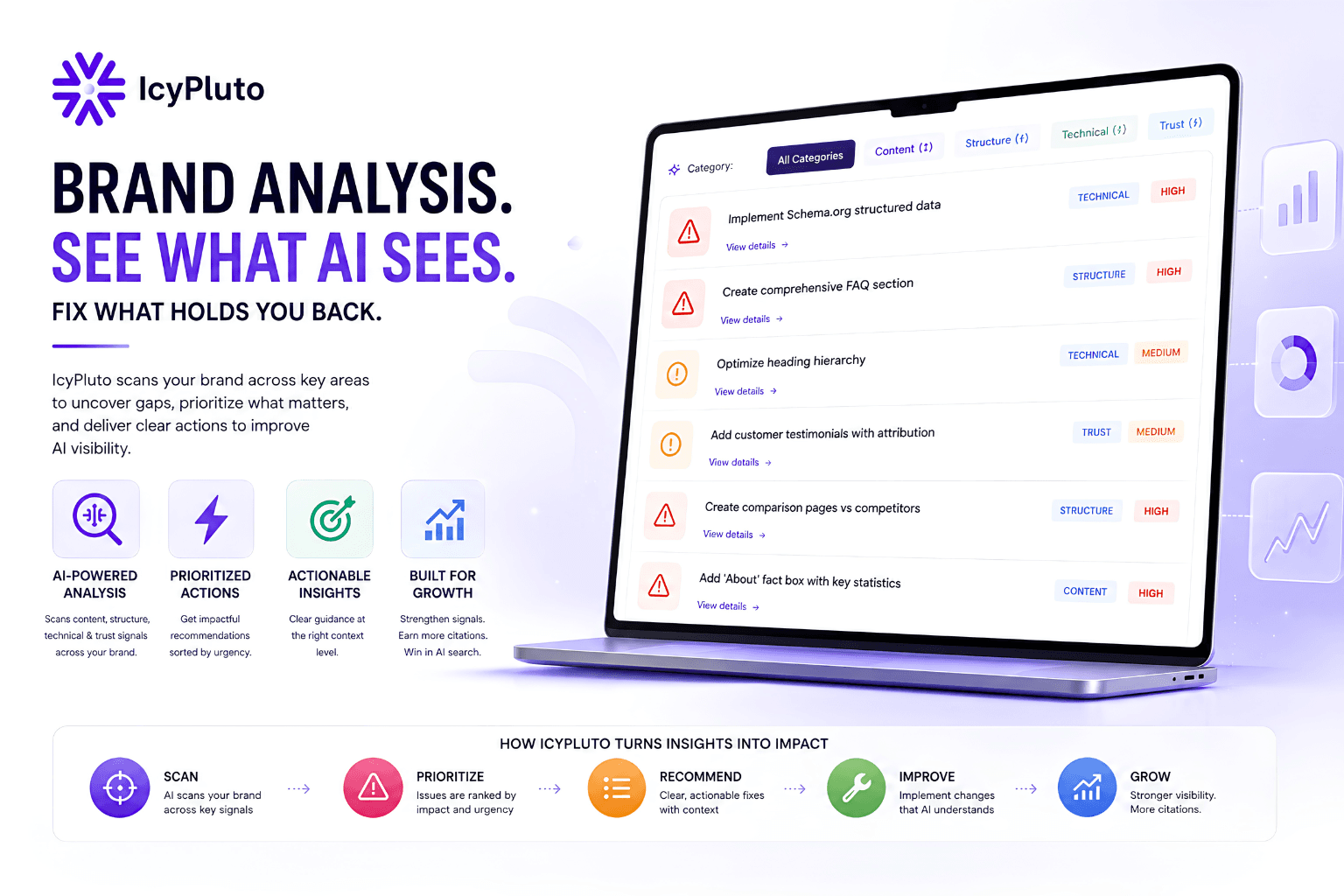
IcyPluto has built a framework that flips the old SEO ratio. Instead of spending 80 percent of time on content production and on-page work, we allocate the majority of effort to entity building, original research, distribution, and AI visibility tracking. This is how we help brands get maximum visibility when AI search is the dominant discovery channel.
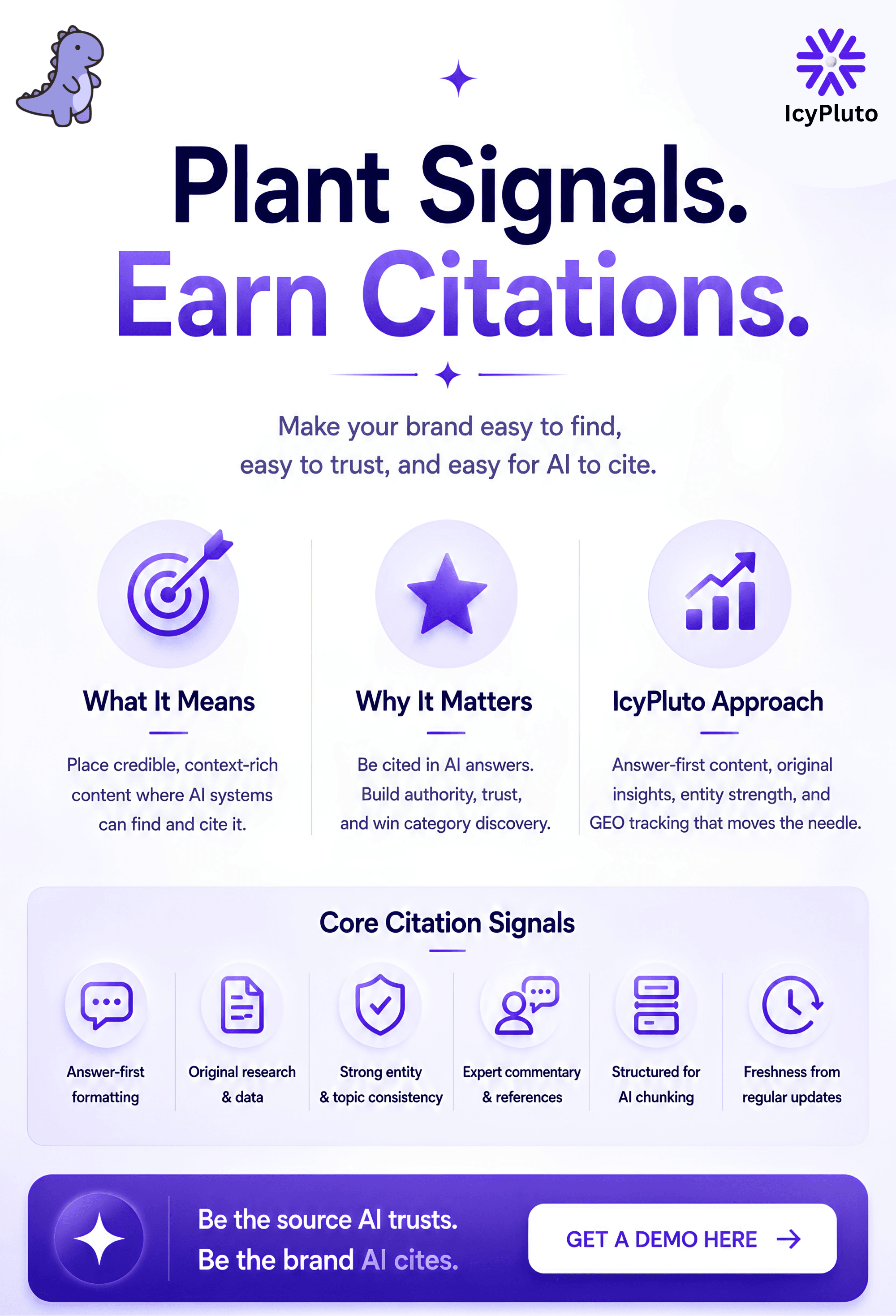
We start with entity and brand building as the foundation. Every brand gets a comprehensive entity audit to identify gaps in how Google and LLMs recognize them. We map existing mentions, check consistency across platforms, and build programs that earn visibility for the brand and its senior people across the web. For B2B clients, this includes securing executive mentions in industry publications, building profiles on G2 and Capterra, and creating content that positions leadership as experts in their sector. This work has doubled non-branded visibility for engineering clients in under 12 months.
Original research becomes our flagship asset. We help clients scope, run, and publish proprietary data that journalists will pick up. This includes annual industry reports, Q1 2026 marketing trend analysis, customer surveys, case study results, and usage statistics. We have helped clients create content that earns 40 to 60 percent more external mentions because the data cannot be synthesized by AI. This creates defensible authority that competitors cannot copy.
Distribution is not an afterthought. We assign explicit ownership to making sure good content reaches the people it was written for. This includes hybrid SEO-PR work for larger teams and relationship building for smaller businesses. We map journalists and bloggers who cover your themes, engage with their content, and position your brand as a valuable resource. We do not wait for content to be discovered. We actively put it in front of the right people.
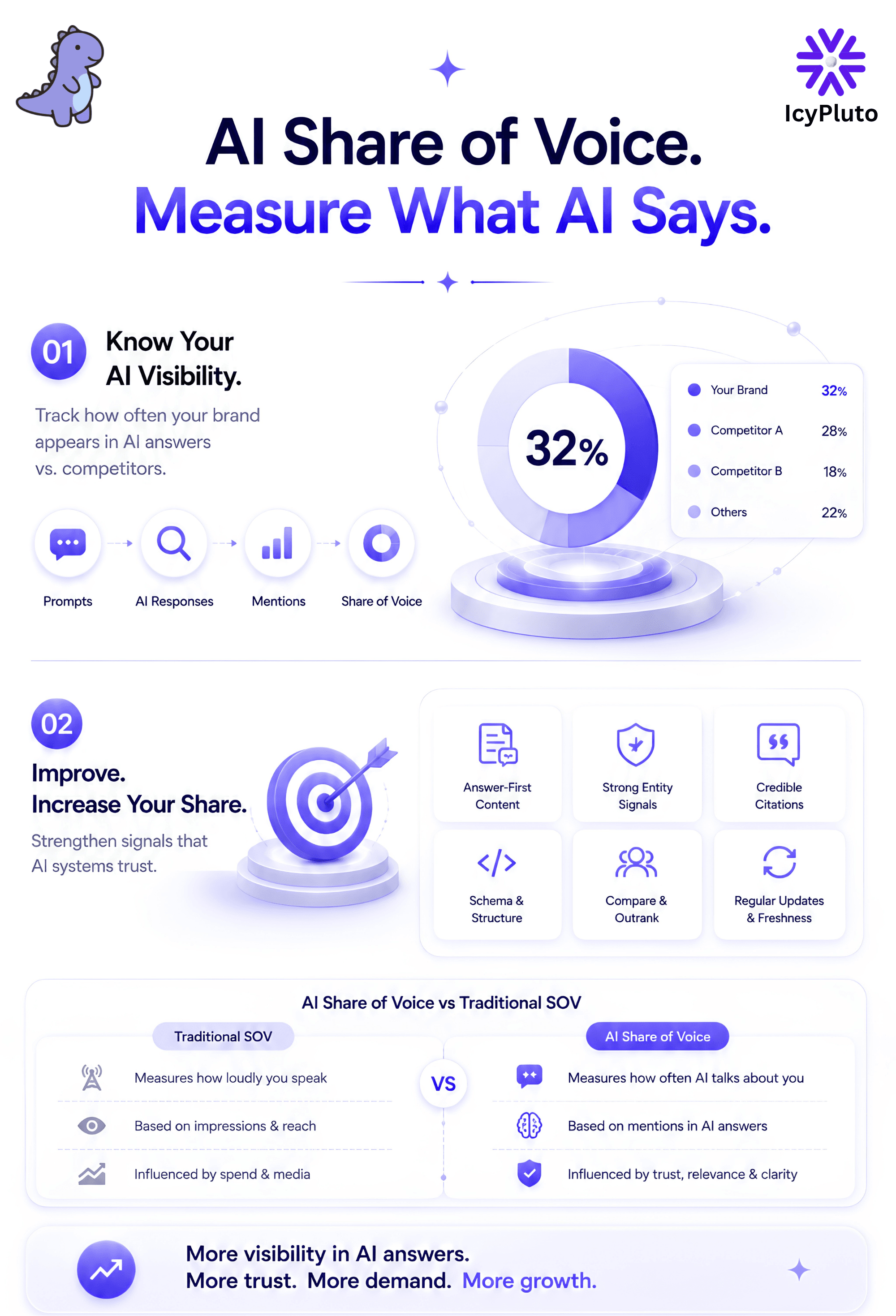
AI search visibility gets tracked and optimized continuously. We monitor Share of Voice in AI search, which measures how often your brand is mentioned in AI answers versus competitors. We use tools like the GEO Dashboard to evaluate prompts across multiple LLM models including Gemini, ChatGPT, and Perplexity. This gives us the exact picture of how brands look for specific topic clusters and which AI models perform best. We track attribution gaps that mask AI-driven discovery traffic, ensuring the whole picture is accurate.
Analytical depth separates us from commodity SEO. We interpret messy data, cross-reference across platforms, and produce views of what is actually driving growth. We track first-party data including incoming leads and customer journeys. We are honest about which traditional metrics have become misleading and act on what gaps reveal. This capability helps clients defend strategy in board meetings and make decisions based on what works commercially, not just what looks tidy on a dashboard.
The results show this approach works. Our clients see external mentions increase by 40 to 60 percent. LLM referral traffic grows by 80 percent or more. Share of Voice in AI search results improves measurably. Most importantly, their brands become more visible when decision makers use AI assistants to research solutions. Average SEO conversion rates are 2.4 percent across industries, with B2B SaaS achieving 2.1 percent. We optimize for conversion, not just traffic.[olivermunro]
We reallocate budget from production to strategy and distribution. A senior SEO who can think entity-first and write journalist-ready pitches is worth two midlevel executives churning out content briefs. A part-time research relationship is worth more than a third copywriter. This is a harder internal sell than asking for more headcount, but it is the move that drives real growth.
If you lead an in-house SEO function, the practical question is what to stop scoping and what to start hiring or training for. The honest reframe is that your team probably does not need to be bigger. It needs to be differently shaped. A senior SEO who can think entity-first and write a journalist-ready pitch is worth two midlevel executives churning out content briefs. A part-time research relationship is worth more than a third copywriter. Reallocating budget from production to strategy and distribution is the move, and it is a harder internal sell than asking for more headcount.
The other thing worth saying: Your reporting will get harder before it gets easier. As you shift weight onto entity work, original research, and AI visibility, the lag between effort and measurable outcome stretches out. Be honest with your leadership about that upfront. It is much easier to defend a six-month strategy you have explained in advance than one you have to explain retrospectively when the traffic line dips.
The retainer model needs work. The standard package built around keyword research, content briefs, on-page optimization, monthly reporting, and a bit of link building is selling clients yesterday's discipline at today's rates. It is also increasingly hard to defend when the client compares your output to what they could get from an AI tool and an enthusiastic intern.
The agencies growing right now are the ones that have rebuilt their offer around capabilities rather than deliverables. They lead with strategy and entity work, bring in original research as a flagship asset, treat distribution as a core service rather than an afterthought, and are honest with clients about what they no longer recommend doing at all. They also charge more because the work is harder and harder to commoditize.
The agencies struggling are the ones still selling the 2022 retainer and quietly wondering why renewals are getting harder.
If you are trying to work out where your team or agency sits against all of this, a useful exercise is to look at your last three months of activity and ask: What proportion of the hours went on the work that mattered most five years ago versus the work that matters most now?
For most teams, the honest answer is uncomfortable. As much as 80 percent of the time is still going on content production and on-page work, and the strategic activities that move things forward are getting whatever scraps are left after the production calendar is fed.
That ratio needs to flip. Not all at once, and not at the expense of the basics. But the direction of travel is clear, and the teams that act on it first are the ones that will still be ranking when the next round of platform changes lands.
The discipline has not died. It is just become a different job. The teams that adjust the skill stack now, before it becomes obvious to everyone else, are the ones who will come out of the next two years in a much stronger position than they went in.