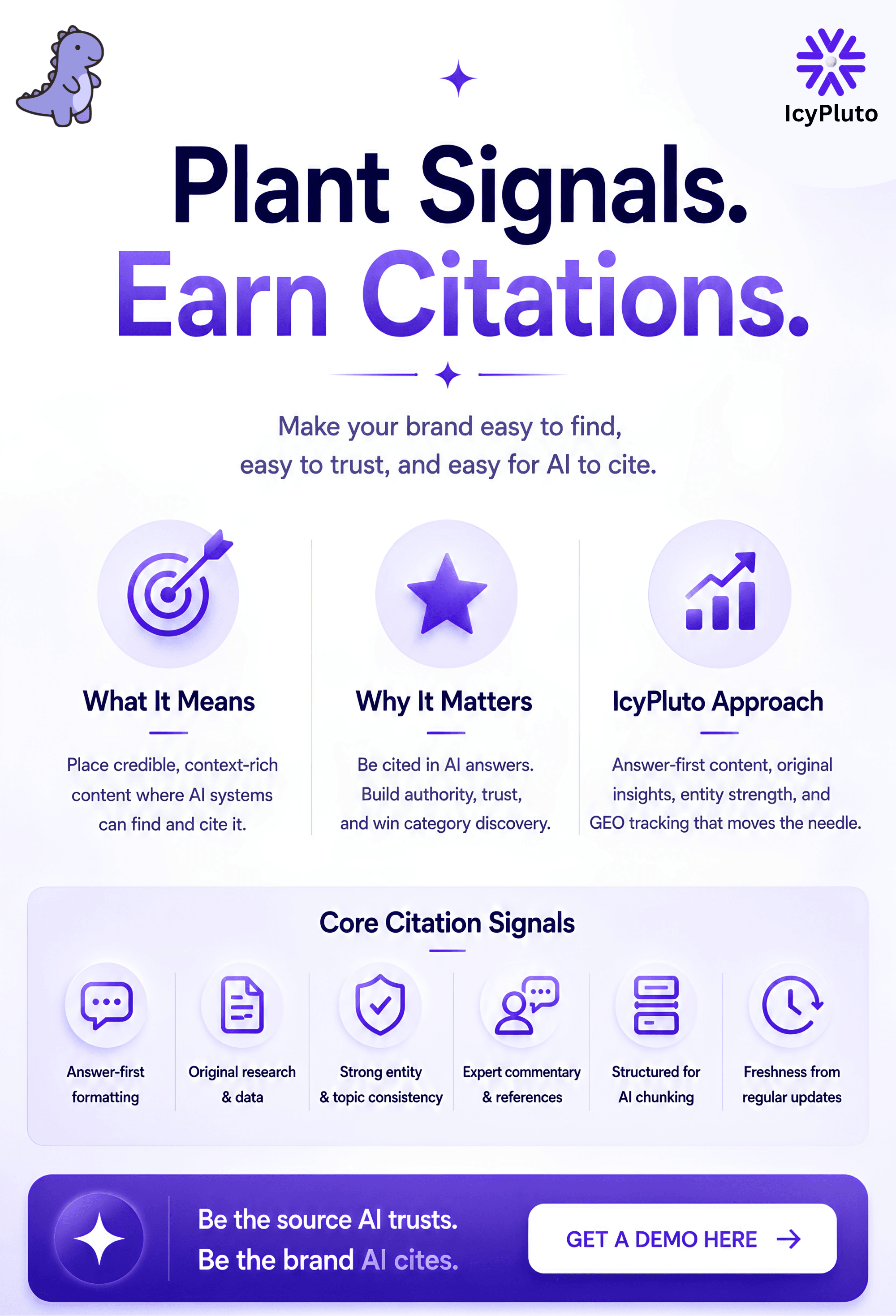
Citation seeding is becoming one of the fastest wa...
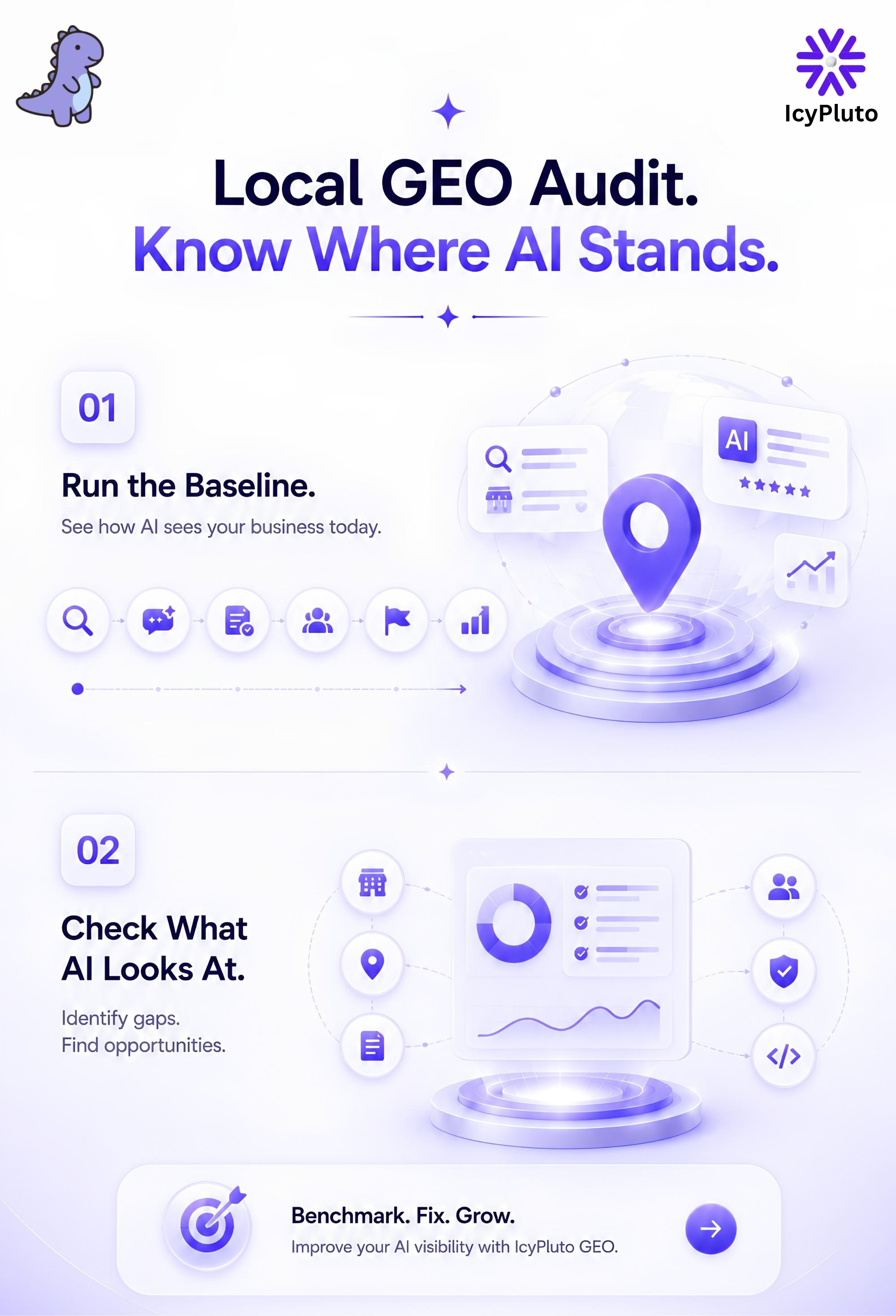
A local GEO baseline audit helps you understand ho...
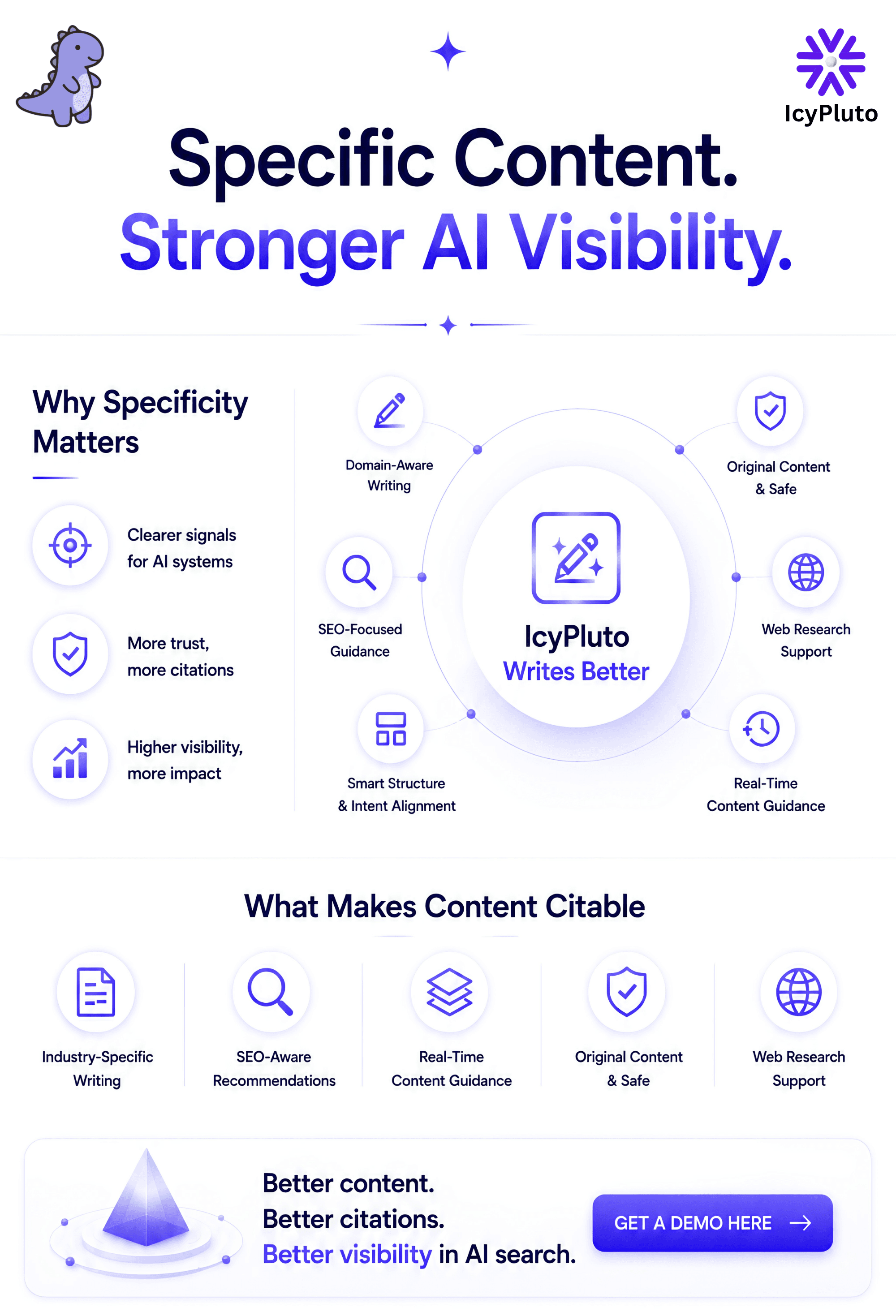
AI SEO writing is getting more specific, and that ...
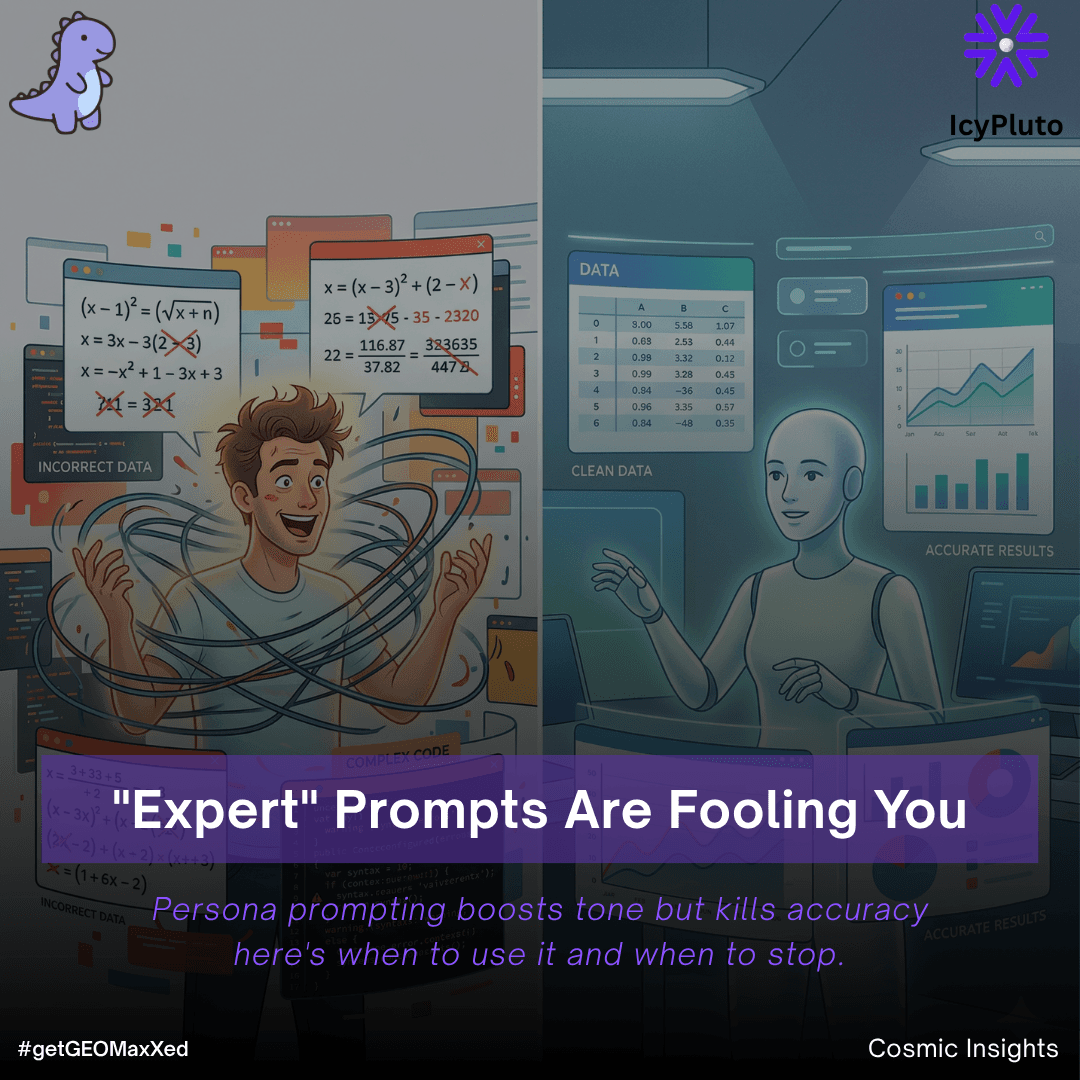
Every marketer, content creator, and AI enthusiast has done it. You open a new chat window, type "You are an expert SEO strategist with 15 years of experience," and feel confident that you've just unlocked the best possible version of your AI tool. It feels intuitive. It feels smart. And in many cases, it does seem to work — the tone sharpens, the structure improves, the output feels more professional.
But a new research study is pulling back the curtain on this widely-used prompting technique, and the findings may completely change how you interact with AI tools. The truth is that persona prompting — the practice of assigning an expert role or identity to a large language model (LLM) before prompting it — is far more nuanced than most people assume. It is not a universal upgrade. In fact, for certain types of tasks, it is actively making your AI outputs worse, not better.
At IcyPluto, where we operate at the intersection of artificial intelligence and intelligent marketing as COSMOS' First AI CMO, understanding how AI thinks, responds, and performs is not just academic curiosity — it directly impacts the quality of our work, the accuracy of our strategies, and the results we deliver. This research matters deeply to what we do every day. Let us break it all down.
Persona prompting refers to the technique of framing your AI prompt with a role or expert identity before asking your actual question. Think of phrases like:
"You are a seasoned financial analyst…"
"You are an experienced software engineer specializing in Python…"
"You are a world-class copywriter with expertise in conversion optimization…"
The logic behind this approach seems completely sound. If you tell the model who it is supposed to be, it should respond in a way that reflects that expertise — more accurate, more detailed, more structured. This technique became so popular so quickly because it genuinely did produce improvements in tone, formatting, and the overall feel of the response. Writers got more polished prose. Developers got more structured code breakdowns. Marketers got cleaner campaign outlines.
But here is the problem: feeling like a better output and actually being a more accurate output are two very different things. And that distinction is at the heart of what this new research is uncovering.
The study, titled Expert Personas Improve LLM Alignment but Damage Accuracy: Bootstrapping Intent-Based Persona Routing with PRISM, examines the real-world effects of persona prompting across eight distinct task categories. The researchers found that prior studies on this technique produced inconsistent results — sometimes showing benefits, sometimes showing harm — which raised a critical question: does persona prompting actually help, and if so, when?
The researchers' conclusion was clear: persona prompting is neither universally beneficial nor universally harmful. Its effectiveness depends entirely on the nature of the task.
To understand why persona prompting sometimes fails, you need to understand two things that happen inside a large language model when it processes your request.
The first is alignment — this is how well the model's output matches human expectations in terms of tone, structure, style, formatting, and safety. When you ask an AI to write a professional email or craft a step-by-step tutorial, alignment is what makes the response feel right and read naturally.
The second is accuracy — this is the model's ability to correctly recall factual information, solve logical problems, and perform precise reasoning that it acquired during its original training phase, known as pretraining.
Here is where the paradox lives: persona prompting improves alignment while degrading accuracy.
When you assign an expert persona to an AI, you are essentially activating its "instruction-following mode." The model shifts into a state where it is trying to behave like the character you've described. It adjusts its tone, chooses its words more carefully, structures its responses to match what an expert would say. This is great when you want polished writing or a well-organized explanation. But this shift in mode comes at a direct cost.
The model becomes so focused on sounding correct — acting like the expert — that it starts drawing less reliably on the deep factual knowledge it built during pretraining. As the researchers put it, the expert persona essentially "distracts" the model. It prioritizes presenting information in the way an expert would rather than actually verifying whether that information is correct.
The paper describes it this way: "During pretraining, language models acquire capabilities such as factual knowledge memorization, classification, entity relationship recognition, and zero-shot reasoning. These abilities can be accessed without relying on instruction-tuning, and can be damaged by extra instruction-following context, such as expert persona prompts."
In simpler terms: you're asking the model to wear a costume, and in the effort to keep the costume on, it starts forgetting what it actually knows.
The researchers tested persona prompting across eight categories of tasks. The results split fairly cleanly into two groups: tasks where persona prompting helps, and tasks where it quietly damages performance.
Persona prompting showed measurable improvements in five of the eight task categories tested:
1. Data Extraction (+0.65 score increase)
When the task involves pulling specific information from a document or source, an expert persona helps the model stay focused on the user's intent and structure the output effectively.
2. STEM Explanations (+0.60 score increase)
Explaining complex scientific or technical concepts benefits from the structured, step-by-step presentation style that expert personas activate. The formatting improves, and the explanation becomes more digestible.
3. Reasoning Tasks (+0.40 score increase)
When the task involves structured thinking — building an argument, walking through a logical sequence — persona prompting helps organize the response.
4. Writing Quality
Creative and professional writing tasks see real improvements. Tone matching, stylistic adaptation, and consistency in voice all benefit significantly.
5. Roleplay and Domain Simulation
When the task is inherently about playing a role or simulating expert communication, persona prompting is exactly what the job calls for.
The thread running through all of these categories is important to note: they are all primarily about style, structure, and presentation rather than about whether a specific fact is correct or incorrect. The model is being asked to communicate well, not necessarily to recall precisely.
In three of the eight categories, expert persona prompts consistently made performance worse:
1. Mathematics
Math requires precise logic and exact computation. When a model is trying to act like a math expert instead of simply doing math, errors creep in. The persona distracts from the actual calculation.
2. Coding
Similarly, coding depends on strict logical accuracy and syntax correctness. An expert coding persona improves the formatting of the explanation but introduces subtle logical errors that a neutral prompt might have avoided.
3. Humanities and General Knowledge (Factual Recall)
This is perhaps the most surprising and most consequential finding for everyday AI users. Tasks that involve recalling established facts — historical events, well-documented statistics, established definitions — actually perform worse under persona prompting.
The numbers make this stark: on the MMLU benchmark (a widely used test for general knowledge and factual recall), the baseline accuracy was 71.6%. Adding a minimal persona prompt dropped that to 68.0%. Adding a longer, more detailed expert persona dropped accuracy further to 66.3%.
That is not a rounding error. That is a meaningful degradation in factual reliability, and it scales with how detailed and elaborate your persona description is. The longer and more "expert" your persona prompt, the worse the factual accuracy becomes.
One of the most counterintuitive findings in the research is that the length and detail of a persona prompt matter — and not in the way you might hope.
Common sense says that a more detailed expert persona should produce a more refined result. If "You are an expert" is good, then "You are a Harvard-trained economist with 20 years of experience in macroeconomic policy and a specialization in emerging markets" should be even better. Right?
Not for factual accuracy. The research shows the opposite is true. More detailed persona descriptions amplify the alignment behaviors even further, which means the model becomes even more focused on matching tone and style, and even more likely to prioritize sounding correct over being correct.
As the paper notes: "More detailed persona descriptions provide richer alignment information, amplifying instruction-tuning behaviors proportionally."
There is also a model-level dynamic at play here. AI models that have been more heavily fine-tuned to follow instructions — the kind of models optimized to be agreeable, helpful, and conversational — are more "steerable" by persona prompts. They respond more strongly to the expert role assignment. This means they get bigger improvements in tone and safety behavior, but they also suffer larger drops in factual accuracy when given persona prompts. Ironically, the more helpful and instruction-following a model is designed to be, the more vulnerable it becomes to this trade-off.
Recognizing that persona prompting is a conditional tool, not a universal one, the research team developed a framework called PRISM — Persona Routing via Intent-Based Self-Modeling. Rather than treating persona prompts as a default setting or a best practice, PRISM routes them selectively based on what type of task is actually being requested.
The core idea is simple but powerful: before applying a persona, evaluate what the task actually needs. If it needs style, tone, structure, and alignment — activate the persona. If it needs factual recall, precise logic, or verified information — use a neutral prompt instead.
This is a workflow-based approach to AI prompting, and it reflects a broader shift in how professionals are starting to think about AI usage. The goal is no longer just to get a good-looking output — it is to get an accurate, reliable, and effective output. Those two things require different prompt strategies.
For teams like ours at IcyPluto, where AI is not a novelty but a core operational asset, this kind of structured thinking about prompt design is exactly the level of sophistication the industry needs to move toward.
Let us bring this out of the research lab and into practical, day-to-day application.
If you work in content, SEO, digital marketing, or any field that relies heavily on AI-generated or AI-assisted outputs, here is how to apply these findings right now:
Use persona prompting for:
Writing blog posts, articles, and long-form content
Drafting emails, social media captions, and ad copy
Generating structured outlines and content frameworks
Tone matching and brand voice consistency
Roleplay scenarios and simulated conversations
Formatting complex information into readable structures
Avoid persona prompting for:
Fact-checking or verifying statistics
Technical SEO audits that depend on precise data interpretation
Legal, financial, or medical information that must be accurate
Coding tasks where logical correctness is non-negotiable
Research-driven tasks where factual precision matters
Mathematical analysis or data calculations
The recommended workflow:
Use a persona prompt to generate your content draft — this is where the style and structure benefits shine.
Switch to a neutral, non-persona prompt (or a stricter verification mode) to review and fact-check the output.
Never assume that an expert persona has improved accuracy. Always verify facts independently before publishing or acting on the information.
This two-stage approach captures the best of both worlds: you get polished, well-structured content from the persona phase, and you preserve factual integrity through the neutral verification phase.
What this research ultimately reinforces is something that has always been true but is becoming increasingly important to state clearly: AI tools are not infallible experts. They are sophisticated language systems that can be guided and shaped by how you communicate with them — but that shaping has consequences, and those consequences are not always visible on the surface.
When an AI gives you a confidently worded, beautifully structured answer, that presentation can create a false sense of security. The output looks authoritative. It reads like it came from an expert. But the research shows that the more you push an AI to perform expertise, the more you risk sacrificing the actual accuracy of the underlying knowledge.
This has profound implications for businesses and marketing teams that are scaling AI usage across their operations. The risk is not just one incorrect output — it is the systemic, invisible degradation of factual reliability that comes from over-relying on persona prompts across an entire content or research workflow.
At IcyPluto, we believe that working with AI intelligently means understanding not just what it can do, but how it behaves under different conditions. The teams and companies that will get the most from AI in the coming years are not the ones who prompt the hardest — they are the ones who prompt the smartest.
The future of AI-driven marketing is not about telling AI who to be. It is about knowing exactly when to let it be itself.